Dave Tate said it, I didn't. I'm no expert so theoretically, I have no credibility. After all, I'm just a modestly above-average strong 30-something with a humble blog and a handful of fans and I don't train people for a living. Tate's an expert for sure. He's so expert-ish that his presence, or absence, from T-Nation is a critical element of making that place a worthwhile place to gather information. It was there that he said something that I pretty much knew in the back of my mind without realizing it: powerlifting (and probably most other lifting in general, for that matter) is about shortening the distance you have to move a weight as much as possible to make the lift count as complete.
That's a kind of rule of thumb that I see a lot lately. Since August, I've needed to join a gym to get my broken body to a stationary bike as part of rehabbing my knee after my ACL reconstruction. This is, by far, the longest I've worked out in a gym in over 14 years. So, I've traded in my solitary training existence for spending more time in a gym. As a result, I've seen much more training styles first-hand than I have since my teenage years when I had less than a clue about what the fuck I was doing.
It was kind of like landing on Mars, as much for me as it was probably for them. They seemed as astonished that I would think to do close-grip pull-ups off of ropes as I was astonished about how few different ways they do pull-ups. The rope-thing was a novelty but what drew a lot of attention was doing close-grip pull-ups (oddly enough). Apparently this never entered anyone's mind.
Regardless of whether you're pulling or pushing with the upper body, the wider you spread your hands apart, the easier the pull or the push becomes. There's two reasons for this. The first is that spreading the hands wide de-emphasizes the smaller, weaker arm muscles in favor of the bigger muscles of the upper body. Then, there's the second reason that Dave Tate brought up and that as you spread the hands farther apart, the distance to complete the rep shortens up.
I'll use the handstand push-up as an example here... and a jack-in-the-box.
Here's a wide HSPU...
Now, putting the hands almost under the shoulders...
Like I said, this applies to Push-ups, Pull-ups, and rowing movements. What this information is useful for depends on what you want to do with it. It doesn't just have applications to moving as much weight as possible for the shortest possible distance. That approach works great if you've got lots of iron to play with. Maybe you do. Then again if you're reading this article then chances are you're like me: looking for ways to goose the most work out of a limited equipment supply. You can change the level of difficulty with one movement by just a simple change in hand placement. You can also change the focus of the movement from an upper body workout to a more arms-oriented one with this approach. This is how I use Handstand push-ups to strengthen my shoulders one day and my arms at a later point in the week.
Going for that extra ROM may pay off dividends may also pay off for that one other, pesky detail that too many people who like go get strong don't really want to think much about: their health. Since Dave Tate makes things more legitimate, I'll defer to his words yet again:
Here's the deal. Powerlifting is about finding the shortest range of motion possible.[see?]
Look at the bench press. If your setup and arch is sound, it's a very short (albeit very safe) range of motion.
Bodybuilding, in the purest sense, is the opposite. The most effective movements generally take the muscles through the longest range of motion.
I realized that I hadn't done any full range of motion work for years, and if I were to regain my "functional mobility" this would be where to start.
This isn't to say that I love bodybuilding but it goes to show that ROM is a use it or lose it proposition. Losing it will ultimately break you down. That close-handed HSPU variation easily slices the amount of reps I can do as opposed to the wider-stanced one. BW guys tend to look at their reps the same way that powerlifters look at their poundage: keep the number high. The consequences of that ego trip hurts after a while. Even Tate admitted that (Read the rest of the article, not to mention all of the others, for that matter).
I hope that these ideas and concepts aren't new to my readers' minds. This shouldn't be most strength trainer's equivalent of the the discovery of Vulcanized Rubber (found by accident and never capitalized on by Charles Goodyear). If that's the case, then feel free to self-flagellate as needed. Otherwise, ditch any notions about getting creative, not giving as shit about your body, or caring about keeping your rep count high. Moving the hands closer together here and there is as simple as dropping rubber on a stove so do it more often.
In the first installment of my reaction to rebooted Body's article, "The Health and Fitness Industry is Dead (and that includes you Paleo)," I took a contrary opinion that while there is good information out there not being acted on by the general public, there is a lot more really bad information being acted on by most of the general public. While getting good information out there is a key first step to making a viable health and fitness industry that actually succeeds at making people healthy and fit, it's just a bullet in a gun that's not being fired. Someone has to pull the trigger and get it out into the world.
The author makes one, key error in information delivery: he assumes that the information is being properly disseminated. I don't think it is, and I can see where he would think so. My friend Chip Conrad's comments on this article on Facebook is what brought it to my attention. His comment was eye-opening. Here is a piece of it:
Roughly 15% of our culture is involved in movement to some degree. That's 85% not doing much in the way of being physically human. Why the fitness industry is 'dead' is because there is little geared towards addressing the 85% successfully. The 15% talks, posts and tweets amongst ourselves quite well, but there isn't a strong outreach program to that 85%...
I get the impression that the author thinks that the 85% who watch the Biggest Loser, work out at YouFit-Golds-Planetfitness, and think their Nikes make or break their fitness levels know much about Weston A. Price, Paleo, Crossfit, Mark Sisson, or make a distinction between weightlifting and weight training. Sure, some of these terms are seeping into public gym knowledge but the 85% don't know what they're really all about. As far as I'm concerned, I agree that as part of that 15%, we don't do a great job with getting the word out to the other 85%.
The most obvious explanation involves ego and self-interests. Chip said it before too: we are kind of like an underground movement and we enjoy the fact that we're underground. There is certain amount of elitism that we all enjoy to varying degrees. I see it when I go to the gym. People congregate based on what they enjoy doing (general weight loss-fitness, powerlifters, pseudo-bodybuilders), not regularly interacting with one another. I've not had much contact with Crossfitters because I don't actively seek out Crossfitters. Crossfitters, in return, rarely visit my blog. The one time I can confirm that someone from RKC commented here it was to tell me that I couldn't properly snatch with an Ironmaster Kettlebell. We have our cliques and often times, that's exactly where we stay. Things clearly haven't changed much since high school for too much of the fitness world.
Then, when we do reach out, I see issues about the accessibility of style of strength training that's being put forth. Is it really something that people want to do? Is it something that they can do? As far as I'm concerned, no better example of this exists than bodybuilding. Of all of the competing strength training interests out there, no other has so happily embraced the extreme of their clique quite like they have. Author Randy Roach said it best: bodybuilding has come full-circle. 75 years ago, they were considered freaks. They fought their way into mainstream consciousness and acceptance only migrate back to freak show status. Lots of kids get into sports idolizing they way that their favorite athlete does what they do. Who really wants to look like this...
Anyone want striations on their glutes?
Then there's yet another problem with the marketing. Simply put: things move in trends with the fitness industry. Crossfit may be approaching its raging peak of popularity right now. Eventually, they'll reach a point of saturation and they'll descend out of the limelight and into the realm of parody. It happened with aerobics, bodybuilding, etc. The problem with that is that people need to keep moving far longer than that. What kind of faith can the fitness industry instill in the aforementioned 85% when it keep changing it's collective mind about what the 85% needs to do to get fit?
You don't see either of these guys much anymore. Did Crossfit really think they were going to get people rushing to join with this kind of shit?
While we're on the subject of trends, let's address the diet issue. There is no other example of where the health and fitness industry has squandered goodwill and public faith with schizophrenic-like changes in advice than when it comes to diet. Rather than admitting to the somewhat complicated nature of how the body either gains or looses fat, or gains muscle, the health and fitness industry has happily moves along with new diets that has the following narrative:
Guaranteed to do what they say it will do.
No other will work.
That the last one was wrong.
The problem all along is that there is always an exception to the rule. Take Paleo Dieting for example. I can't speak for the rest of you but I admit that it seems awfully strange to demonize bread, rice and dairy when many strong, healthy cultures have consumed all of these since farming began. Frankly, they were all instrumental in humans making the jump from hunter-gathering tribal existence to civil societies! Now it'll make you sick and kill you if you eat it? I'm guessing it will be matter of time before we laugh at this one much the way we now laugh at Weight Watchers.
That's the issue with how the health and fitness industry has shot itself in the foot for the past half-century. With the infighting and constant reliance on trends as part of their business models, they succeed in making themselves into a joke for the remaining 10.5 months after New Years wears off and the Superbowl sabotages everyone's good intentions. If the 85% are going to get fit and healthy, then the 15% has to come up with a way to get them eating right and moving properly for more than a couple of seasons. That is, if that's the priority for us here, and sometimes I question if we even REALLY care.
Don't you love those questions where people ask, "deadlift vs squat?" Are you as mentally stimulated as I am when someone brings ups a question starting with, "if you could only do x exercises..?" Are you excited to answer questions about programming, sets and reps, etc? Do you eagerly await answering any kind of questions dealing with training percentages?
Yeah, me too. Hypothetical questions are only remotely interesting when you are pondering things that you really can't do. Otherwise, they're a ridiculous and wasteful trip down rhetorical lane that you don't need to bother with. Squat vs. Deadlift? You can do them both, you know. In the same workout, even in the same move (Zercher lift, anyone?) Do you really need me to tell you how many times to do that? Do you realize how far into professional athletics you have to wander before percentages even become extremely relevant to your training? A better question still is do these people get exactly how much time they waste by their paralysis by analysis?
In the past half-decade, I've generally succeeded in not turning this blog into a reliable supply of rants and raving that most strength training blogs descend into so I don't plan on starting now. I also try to look what seems like wasted rhetoric and ask the question if there's something to these questions: a hidden call for help disguised as tomfoolery and general dumb-ass behavior. When I see most of the questions, I can't help but wonder if the real questioned being asked is, "How simple can I make training to obtain awesome?"
I can't even begin to tell you how happy I am that I can do these again!
Most of us already know that the answer is, "surprisingly simple." For those of you who don't, allow me to elaborate on how simple this can be with one example: my pre ACL-tear upper body workout. It was pretty simple: handstand push-ups and Pull-ups (usually neutral grip, no particular reason why). As far as I'm concerned, there is no better yin to the pull-up's yang than the handstand push-up. They're practically the same motion except one is a pull and the other is a push. People smarter than myself have told me that this is a fantastic way to avoid muscle imbalances or tightness. Lastly, there is a lot of work to be done with both of these movements before you can file them away as excessively strengthy- endurancy.
Maybe I resorted doing these because the handles just kind of stick out there. It's still a good pull-up variation
Okay, so you can get lots of upper body strengthening with these two moves, practically covering all of the bases for the upper body musculature. Now what? Oh, yeah, only thing more annoying than the questions about narrowing down exercises: sets and reps. Numbers and training percentages conversations make my mind go blank and get sleepy faster than excessive whiskey consumption. I do have a favorite way to arrange these movements though, and I blogged about it too briefly once before: superset pyramids. I've been an upper body push-pull superset junkie for years. I decided to merge in pyramid work simply because there are so many good things going on all in this style of rep scheme.
the beginning is warm-up
You eventually get to a max set of reps
the descent is drop setting
It can increase your total reps
It's also a great way to get a shitload of volume
That's a lot of ground covered. Since I have an aversion to excessive rest between sets, I've always been a fan of the push-pull superset. Generally, my pull-up and HSPU's numbers are practically dead even. So, I can merge supersetting with pyramids on both and not crap out on one before the other. A my choice rep scheme of Pull-ups and HSPU's used to look like this...
3-6-9-12-15-18-21-18-15-12-9-6-3
(that would be 147 reps of both HSPU's and Pullups)
Did I get results? Sadly, as always, I'm terrible with tracking progress with pictures. At the beginning of the year, I resolved to plunge back into mass gaining. I had hoped to take myself from the dismally-low 172 lbs (stress is a bitch) up to a more acceptable (to me) 200 lbs. Doing this workout Mondays and Fridays I jumped up to 185 lbs by the time I tore my ACL. So, this part of the plan was working out just fine. Next year, I suppose...
So, it really can be as simple as choosing the right two movements and a well thought out rep scheme. Good planning and complicated/complex planning are not the same thing. All you have to do to is quit ruminating over what to do on the internet, pick your poison, and attack it with some seriousness and intensity.
As much as I find strength training interesting, I'm not always interested in talking about it with other people. Originality in the world of weights may have died a long time ago but that doesn't give everyone a reason to have the same four or five reasons for lifting weights, getting their routines from a cultish mothership web site, or doing anything resembling a fitness class. I enjoy being at least a little bit different and I have a severe aversion to following other people's programs.
While I could care less about taking other people's marching orders, I do spend some time reading what other people are up to and using my blog to react to what I see out there. As luck would have it, life has dropped two interesting ideas in my lap that I felt compelled to share with the world. Reversed-Hand Push-ups I've seen these around for years, tried them once or twice, and then discarded them. They were the wrong combination of not particularly challenging and uncomfortable on my wrists and elbows. In other words, they were just nothing more than another piece of high-rep nonsense that plagues BW training. That is until I read this article about reverse-grip bench pressing. For some reason, I wondered if I could use a couple of the cues given in a reverse grip push-up. So, using a seam in my driveway as a guide, I set my hands up so the seam passed diagonally through my hands, much like the bar does in the picture below with my hands just past shoulder width and about the same point as my solar plexus.
While this was more comfortable than previous attempts at reverse grip push-ups, it still wasn't very challenging. So, I decided some more weight was in the order. I opted to throw one of my sandbags (about 50 lbs) around my neck and upper back. Now, I was onto something. I enjoyed the weighted reverse hand push-up immensely, doing 15-20 reps per set.
It definitely solicits gets more pectoral recruitment. Try this right now: put your hands straight out in front of you like you're pushing someone. Now, turn your hands upside down. Notice the difference in the contraction of your pecs? There's also no forgetting about using the Lats when pushing-up. Like the reverse grip bench, this reverse hand push-up is also easier on the shoulders. That may be due to that increase in lat contraction that you felt when you turned your hands upside down. It also gives the biceps more eccentric contraction work too. It seems to dovetail nicely with my standing overhead press work...when I could do standing overhead press work.
Eating Organs One thing that didn't change for nearly a millennia was the rich and affluent had a bad habit of eschewing healthier, more nutrition dense foods. They, in turn, ate the junk food. The Romans grew rye but the rich and royal favored wheat and left the more nutritionally-sound rye to the poor people. Those were the same old days where they killed an animal they ate everything but the squeal. So, it strikes me as odd that when we fast-forward to the 21st century, I had to go to a Yelp-$$ (barely, I can't get out of El Gaucho Inca without spending $100 for two people) restaurant to eat calf thymus glands and pancreas (aka sweetbreads) .
Yeah, that's a mistake that we don't eat organ meat like our ancestors did because, generally-speaking, offal is more protein-dense than muscle meats. That's just the start. After I fell in love with sweetbreads, I stumbled across this article on T-Nation. Who knew that organ meat could have that kind of micronutrient content? Most organ meats totally kick muscle meats ass in micronutrient content. That's why there are cultures that can subsist on almost nothing else but meat and not suffer the diseases that we associate with not eating enough fruits and vegetables. If you think about it, that all make sense. Most micronutrients are supporting some kind of organ function. So, it only makes sense that they're concentrated more in the organs than in the muscles.
Maybe Jack Lalanne, Joe Gold and Armand Tanny were on to something when they would raid slaughterhouses looking for cows blood to drink. Yeah, I've also ate cow's blood (in blood sausage). If you care to take a break from looking up porn or celebrity gossip, check out the protein content, and the price, of cows blood. I doubt you'll find a cheaper protein out there. I'm even a fan of the Scottish dish known as Haggis. If burly men who invented throwing telephone poles for fun eat it with pride then maybe there's a lesson for the rest of us to learn.
So, sweetbreads are awesome. I'm not the fan of liver that TC Louma is. If you want an organ meat that has a similar texture to the muscle-meat you're used to then try heart (just don't cook it past medium). Best of all, these nutrition powerhouses (are you sick of that phrase yet?) are cheap since they're barely considered good enough for dog food by some people's standards. Their loss.
Anticuchos: Grilled beef heart. That green sauce kicks ass too!
If you've ever driven in a crowded parking lot and pondered why people follow the next five cars in front of them, knowing they won't get the first available spot then you've got an idea of how I feel about our subculture. Yeah, we all move in between the same lines and we all want to arrive at a good spot but we don't need to follow everyone else to get there. We can take a turn away from where everyone else is going. Who knows, we might even find what we're looking for quicker. In other words, we don't all need to bench press and subsist on chicken breast and protein powder.
A special thanks to my lovely wife, Melissa,
for the gracious help with the video and photography!
Weighted vest/jackets are a superb way to add extra resistance to your workout whether you are running, jumping or lifting weights. I have been known to go dog walking in my weighted jacket, which helps with increasing training volumes without taking any extra time out of your usual routine.
As weighted vests can be very expensive to buy, it would be a great idea to have a go at making your own.
Here's a superb weighted jacket build Instructables
In case some of you use Facebook to keep up with what I'm up to, then chances are, you saw me mention that there are too many interesting things out there and I just can't get enough time to blog about them as life unfolds before me. The link above was one such article, posted by a friend. It's long but worth the read. If you haven't sunk your eyes into it, then click above and then we'll talk...
The title alone is catchy, in a disappointedly-haunted sort of way, but it's probably true. The fitness industry has clearly not worked. For the past 40 years of the existence in the USA of reasonably-mainstream health and fitness clubs, diet trends, the supplement business, and gym equipment in the population has become a baffling story of living longer in the most unhealthy manner possible. Sure, we can expect to live to 80 but things are getting to the point where our youth is considered finished off by the time we now hit 25 since we're so fat and sick all the time. The health and fitness industry as most of us know it has existed in this puzzling time period and done nothing to make people live long and healthy simultaneously.
How to live long and unhealthy simultaneously.
So, something has to change. The questions are obviously what and how.
While this article was thought-provoking, and will probably end up inspiring at least two or three other blog entries of mine, like any good conversation material I don't think it was all quite right. While there is three-quarters of a century worth of information out there for us to reference about eating, exercising and being healthy it's not all correct. In fact, most of it is horribly wrong. Furthermore, the right information isn't in the hands of the people who could use it the most.
There are large swaths of the health and fitness industry that still believe in calorie counting as best way to maintain a healthy body weight. There are people who still think that cardio is the best form of exercising. You can still find medical professionals that will tell you squatting is bad for your knees. Others still hold onto an idea that was "proven" by feeding a rabbit (which is rarely used in any animal testing to simulate human beings) a high cholesterol diet even though said animal is strictly herbivorous. Women still buy the notion that weight training will make them bulky. The Shake weight saw the light of day as a legitimate fitness tool instead of as parody of infomercial exercise gear.
Furthermore, the people who ought to know this stuff...don't. Just like it's not hard to find people to give you bad information about exercising and eating, it's not any harder to find a health professional that doesn't have a clue about how to find complete health fitness. Too many doctors believe the bullshit I mentioned above. Or, how you can go to a hospital and be fed food as healthy as what you might find at Golden Corral. Lots of people who do know about eating right don't really know or care how to properly exercise. The exercise people often questionable diet advice and don't really care about being healthy. The unfortunate truth about the history of modern medicine and the modern health and fitness movement is that they've rarely played well, working contrary to one-another rather than together. Even those two factions have their sub-groups that bicker amongst each other.
The publication known as Physical Culture[Bernarr Macfadden's magazine]....is an outstanding example of the money that is to be made from catering to ignorance and furnishing a contact between the quack and his victims...
The student of journalism is always suspicious o a slogan of this type whether applied to magazine or newspapers, for he knows that usually those publications that boast that are prepared for people who think they are actually edited for morons.
American Medical Association Bulletin, 1923
I've regularly thought that part of my education was faulty since there wasn't, at least, one semester devoted to learning about the human body and how to take care of it properly. Then again, since information out there is so jumbled, incorrect and contradictory what good would it have done for me to take such a class anyway?
The fitness industry doesn't get results that people want see because they continue to pass around bad information on how to get to a stronger, healthier place. You don't get results when you have bogus facts to start out with. If this doesn't get cleaned up then they can look forward to a continued descent into a parody rather than a useful reason for people to spend their money. I agree with the article that getting the information right isn't enough but as far as I'm concerned, it's the first place to start.
I swear to whatever gods are up there and/or in another dimension that as soon as I get this knee back to normal, I'm going to squat every, single day for a long, long time. I don't care what kind of squat or how much I can handle I'm going to pull a Johnny Broz and not let a day pass without some sort of hips-back action. That's how tired I am of looking down at my left leg while doing PT and realizing that it's only a matter of time before my neck is thicker than my left leg. Of course, this isn't just from the months-long inaction of my left leg. It's also the results of my weeks-long, re-kindled craze for training my neck.
This wasn't a wholly original idea of mine. Jamie Lewis did two, timely blog entries (here and here) about neck training a couple of months ago. I realized then that this was a body part that I could work out while not putting any strain whatsoever on my bum knee. What I find both fascinating, bizarre, and unfortunate about neck work is how common it used to be. You don't need to do an extensive search on the Sandowplus.co.uk website to find a picture of some old-time strongman with a massive neck. A bit more reading and you'll find out how they did that. It was considered to be an essential part of strength training from the late 1800's until, at least, the 1930's.
Obviously didn't skip neck training...
Since those times, neck training has fallen past the point of underground training into the realm of what even a lot of "hardcore trainers" consider borderline-insane. The only groups of people that I know of that make an effort to train the neck with any frequency are boxers, wrestlers, and Navy SEALS. In other words, only a small group of people who regularly run the risk of getting their head or necks fucked up on a regular basis. The biggest risk the average gym rat has of hurting their necks is by looking at a piece of ass to their left too fast and even then, their necks are likely so weak that even that could do some damage.
The Navy SEAL explanation, as I heard it years ago, for the importance of neck training was pretty simple: the neck carries your head...which protects your mind. You may not be punched in the head regularly or wearing a heavy helmet on your head for HALO jumps but that doesn't mean that you have no business making your neck muscles strong. The neck is part of your spine and since when do we think it's a good idea to neglect the spine? You can also increase the size of your upper traps if you start neck training, if you're into that sort of thing.
So, neck training is as neglected as it is important. How do we train the neck?
The Rules Regardless of whether or not you grab iron or elect to do BW training with your neck, there are rules that apply equally to both. The first thing about the neck is that it has to be warmed up. The neck could easily be the most susceptible body part to injury. Still, there is no need for a rocket-science 20 minute warm up procedure. Just gently turn your head a few times in the directions that you plan to move it when you train. The next rule is high repetitions. You have to do a lot of volume with neck training to see results. The movements are very short and doing low reps won't stimulate shit, even with a really heavy weight. Think 15+ reps per set...or 30+ seconds of work. The final rule is slower, controlled reps. Remember The Bodyweight Files most fundamental mathematical equation here: SPEED-CONTROL=INJURY Bodyweight Neck Training Believe it or not, Matt Furey probably gave the best BW neck training advice and nobody really noticed. I can't blame everyone for that either. Furey made millions off telling people that the wrestlers bridge could strengthen the spine like no other exercise while improve sexual function, curing foot cancer and eradicate fish herpes outbreaks. What more could you possibly need if you had a pencil neck, a flaccid prick and a disorder that only animals with gills get? Yes, my first foray into neck training was the wrestlers bridge but from the neck training standpoint, I think that there are two other options that work better.
The first involved getting into a headstand with your feet against the wall. From there, use the hands only to maintain balance while you roll your chin to your chest and back. Then, roll the head side to side so each ear touches, or almost touches, the shoulders. Some kind of padding on the floor really helps on this one. While the forward and backward rolling does yield results, I skip it because I have a weird, egg-shaped head that makes this maneuver painful and leaves a bunch of redness on my scalp. I mainly stick to the side-side movement. This is a training effect that's hard to pull off with any other neck training.
The second one that I liked was what I call the straight bridge ( I forgot what Furey called it). Instead of resting on your feet and forehead, you grab two chairs, place less than the length of your body apart, and lay down with your feet/ankles on one chair and your head resting on the other, keeping your body as straight as possible for as long as you can. This is absolutely brutal on the entire spinal musculature, including the neck. Even 30 seconds of this will get your attention like no other iso-hold could.
The Weighted Stuff I opted to buy a neck harness when I was getting ready for my surgery. There's not too much to explain. Sit down while leaning forward with your back straight, start with the chin to the chest and carefully lift the weight until you're looking upwards. Like I said above, do a lot of these per set... and lots of sets. Again, under control.
The second piece of harness lifting that I like to do is what's generally called neck crunches or curls. You'll be lying down with the weights hanging behind your head (you may need to hold the harness in place with your hands to keep it from slipping off. Just don't use your hands to pull the weight!) off from a bench. You might be able to get away with a bed if you're not lifting much weight (less than 40 lbs...which may be okay since you won't use as much as you do with the first harness exercise). From that position, bring your chin to your chest and back down. You'll know when you're doing this one right because you'll feel like something's going to rip off your collar bone. Do it wrong and it'll feel more like an ab exercise.
Advice from Glen: don't get cheap with neck harnesses. Apparently he's broken two. I bought a Spuds neck harness and while it's crudely put together, it does seem to hold up to the weight. My early pictures of my neck training were with 35 lbs. I'm now up around 75 lbs, training my neck two or three times a week, and it's still doing well. Also, find a neck harness that doesn't put the lifting straps directly over your ears. Elite FS's neck harness is wonderful for painfully folding your ears under the tug of the weights. Spuds goes in front of the ears so the strap just rubs annoyingly on the front of the ears rather than crushing them.
Yeah, that's a good reason to splurge on a good neck harness...
Another, more indirect option that I've done for months now is doing weighted BW movements (dips, pull-ups, and push-ups) with chains wrapped around the neck. Prior to getting back into neck training, I did a lot of these with 30 lbs of chains around my neck. In the past five weeks of neck work, I've put on about a half-inch on my neck, 17" to 17.5". While my starting point wasn't spectacular, it's hardly pencil-necked for someone around my size (5'10" and 175-180 lbs) . Putting weights around my neck during BW movements was the prime source of this.
As I slowly begin the crawl back to normalcy from my ACL reconstruction, I find myself able to do a bit more in the gym every time I show up. I mentioned to a guy I met at a gym that I take an off-day by training my neck. He looked at me like I had just shit my pants, reached around, stuck my hand in my ass, and took a taste test.
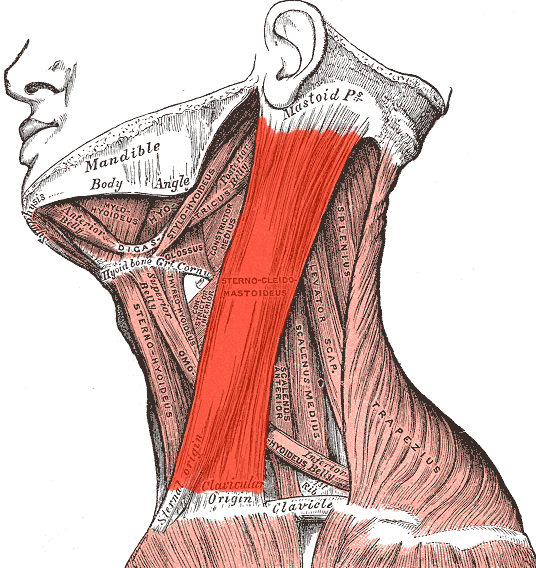
There is no good reason to treat the neck like some sort of glass-like appendage on your body. There's a perfectly good reason why the second-biggest muscle in your back (trapezius, dumb-ass) inserts at the base of the skull, why the sternocleidomastoid muscle (yes, you should know what that one!) is about as thick as a small bunch of pencils on even a skinny-ass human, and why there are a pile of little muscles in the neck that practically rival the shoulders in quantity and obscurity. That's because, like your shoulders, your neck should be big and strong. If you have a weak neck and shit yourself when merely thinking of lifting 30 lbs by your neck, then you should consider sticking your hand in your ass and taking a taste. Or, remedy the problem by getting some neck work done now.



_-_Bernarr_Macfadden_as_David_-_1905_ca1.jpg)