Sunday, July 21, 2013

Don't Under-Do it...and a recap of my ACL reconstruction

Be The First To Comment
As I started putting weights on my new neck harness and getting ready to start lifting, my mother strolled in.  Shocked by seeing a small pile of iron hanging from my neck, she asked for an explanation of what the hell I was doing.  Of course, I explained that this would help strengthen my neck.  Despite doing the kind of slow and under control reps anyone not a strength geek could spot as being careful, she admonished me, "Don't over-do it."  My mother is one of those people who doesn't exercise much and finds infinite, often annoying, reasons not to.  I returned the favor.  "Thank you.  Don't under-do it, Mom!"  I think that this is going to become my standard response to anyone worried about me over-doing my training. 

I'm getting ahead of myself. 

Yeah, I got my ACL reconstructed last Thursday.  That also happened to be the first surgery that I've ever gotten in my life.  I fell at work on April 22 and it's been a slugging match with my company's workman's compensation insurance  (never fun) and trying to get a time where someone can replace me at work while I recuperate.  Mobile centrifuge treatment plant operators don't exactly grow on trees in the United States.  By the way, if you knew how to do this but didn't submit a resume when I mentioned that I needed ACL surgery, then you suck and you should stop reading my blog out of shame and common decency. 
Dude, where's my ACL?
I opted for an allograph at my doctor's recommendation.  That's a fancy way of saying I bummed a piece of ligament tissue from a dead body that wasn't using it anymore.  Every knee surgeon apparently has their own opinion about what reconstruction option is best (autographs:  harvesting a chunk of your own hamstring or patella tendon) and my surgeon explained that while patella grafts are generally considered to be stronger, they have a longer recovery time and since I wasn't a professional athlete, I'd likely never test the strength of the reconstruction.  Besides, he did something kind of cool that I'll get to in a minute.

So, After two months of crutching, barely walking and impatient waiting, I got surgery.  Fortunately, I was the second surgery of the day so I didn't have to endure thirst and hunger for an entire morning and afternoon.  Pain management was an issue.  They didn't give me enough drugs out of post-op to make me feel painless.  Apparently, I succeeded in life by having a high tolerance to drugs without actually doing drugs. 

They asked me to write, "yes" and "no" on which knee to operate on.  I can do better than that..
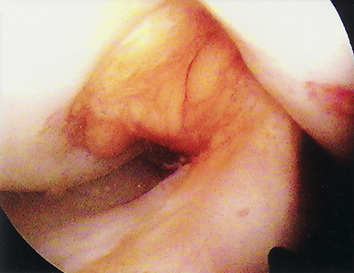
At my first doctor visit, he explained that instead of pulling out my disappointment of an old ACL, he put the dead guy's piece in, grafted the two together, and put them back in their place.  So, my ACL is double the thickness.  I thought it was a cool trick.  It certainly ausages the disappointment of not being able to see a piece of my ligament pulled out of my body.  I thought it would have been neat to see.
ACL back in place.  Better!
Now, comes the fun part:  Physical Therapy.  I lamented to my Physical Therapist that I spent the first four months of this year pushing around a GMC 3500 pick-up around at 5:00 am for leg training.  Naturally, I was so pleased to hear that it would be five months and three weeks before I could get back to that.  Now, I have to get focused on getting my knee straight and my heel to my ass.  This is clearly a humbling experience. 
 
I actually shaved my own leg before surgery, just to make it clear which one they needed to work on.  The nurse said I did a better job than her drag queen son does on his.  I guess that's a compliment. 

Now, if you thought that I'd no nothing else other than PT then you confused me for a chronic overtraining-worry wussy.  Now, since I never had surgery, I never understood the sensation that simple crutch movement could make for a painful, shit-my-incision-are-going-to-explode open feelings in my legs.  I do have an machine that circulates cold water through a pad that I wrap around my knee.  I thank the heavens my surgeon demanded that my insurance company buy it for me before they operated.  Basically, if I have that, pain is manageable.  So, what can I do with this thing on my leg that doesn't send me rushing for pain medicine and my machine? 

Yeah, the neck training thing.  One day I do 30 minutes of neck training.  The next day I work on my crush grip with my CoC's.  These are two things that I can do that in no way make my surgically-repaired knee ache or carry even a remote chance of aggravating it.  Plus, I don't think I stand a chance of slowing down my recovery by training too hard. 

Plus, the neck and the hands recover pretty quick, as long as it's not over-done.


SHIT!  NOW I SAID IT! 

So, I'll keep y'all posted on my progress and any wild revelations that I have while I recover.  Thank you for the get well wishes.  Hopefully, I can get back to normal as fast as possible. 

Thursday, July 4, 2013

Iron Addiction II: Who To Listen To?

Be The First To Comment
If there has been a somewhat-reoccurring theme to this blog is that strength training has relied way too much on the pounds of weight moved for quite some time as the number one measure of value.  The thought process of moving as much weight as possible influences many things from our judgment of our own strength to the movements we choose to do to make us strong.  Another, lesser thought-of issue that comes up now and then with iron addiction is who we choose to listen to for advice with training. 

I like Paul Carter's feed on my Facebook wall as well as his blog.  He writes so much I'm often left wondering how on earth he ever gets any work done.  Anyway, he had this to say after being one of the speakers at a recent Juggernaut Training Seminar in Chicago:
I'd like to address something here, because I was asked a question that was intended to mock me, but in all reality it made me feel pretty fucking awesome.

The trolls question was "how did it feel to be the weakest speaker at that Juggernaut seminar?"

Well, that's a great question.

I've been training for almost 25 years. Unlike Eric Lilliebridge I was not born a genetic mutant. It took
me a few years of training before I could bench 135.
After a few years of lifting I remember squatting 155 for a set of 10, and it was so hard I felt like my liver was going to explode. I didn't do those again for a few more years. They were hard! Who wanted to do that shit?
 
My best total, no belt no wraps is only 1686. Hardly the stuff of legends.
 
After the seminar I walked up to Ed Coan, the greatest powerlifter that's ever lived, and shook his hand and told him what an honor it was to sit next to him. Ed shook his head and told me, "Paul, you're as smart about all of this stuff as anyone up there."
 
That's the greatest compliment I've ever received in regards to training in my life. What could top that?
 
All the years I spent fucking up and busting my shit up and trying to get better...all the years I spent reading and trying to understand things and fucking with programs....all the years I spent writing and putting my own shit out there....that's what got me there.
 
All of those things are as good as any total because I sit on top of 25 years of knowledge and experience. And while a world record anything would be nice, I was able to sit with record holders and speak alongside them as a peer.
 
So you see, I'd like to thank you for asking me that question because it was one I asked myself at the seminar. And my answer was "I'm here because of the other things I bring to the table." That thought was reaffirmed to me by the greatest ever at said sport.
 
Not only that, but after 25 years I know that I'm just entering my prime. If I can total 1686 with no belt, on a torn groin then my best meets are yet to come.
 
So many of us have aspirations of becoming something, or doing something, but sometimes aren't on the right road to get there. I would have never been in on that seminar, if I hadn't started writing and putting my ideas out there. It was those things that led me to that place. My lifting at this point, wouldn't have gotten me there.
 
The road to our zenith may not be the one we believe we are supposed to travel. People often find out that they have to take a completely different route, in order to end up in the place they desire to be.
 
So how did it feel to be asked to sit in with a group where I was the "weakest" guy there?
 
Pretty fucking awesome.
 
Because strength isn't just measured by pounds on the fucking bar.
 
Like I said, he talks a lot.  The mockery does bring up an interesting question:  Are we obligated to take seriously training information that only comes from people who can move prodigious amounts of weight?  How do we go about determining who we listen to for training advice? 
 
Taking advice from people who move massive amounts of metal often results in reeking of douche-baggery.  I've taken tips on how to do an exercise properly from people who couldn't move the same amount of weight that I can.  I took tips on how to row from someone who probably could barely row for reps what I could do for high volume.  Should I have disregarded what they had to say?  It was only my second or third time doing weighted rows and the person giving me instructions was a woman who has taught people how do this stuff for years. 
 
Subsequently, certain people are gifted.  Being blessed with lots of muscle mass and the right structure to pull off immense lifts doesn't do anything to teach you how to do what they do.  If you're less gifted, you need to learn technique.  This kind of big lifter may not be able to impart what comes naturally to them onto you.  

Then, there are egotistical fuckers who doesn't want you to be better than they are.   It's unfortunate but there are people out there that are only okay with your success up to a point where they feel threatened by you.  It must be easier than trying to constantly improve.  Lazy asses. 
 
Of course, some people aren't good at teaching others either.  While my solitary fitness existence doesn't allow me to teach a people about working out in peron, I do the bulk of the training at my job.  If there is a few things that I try to keep in mind, it's these things: 
 
  1. Patience.  People who have a set idea of how long it's going to take to teach someone something aren't good for teaching.  It can be a tedious process to get people to learn what it is you're teaching them and impatience doesn't help the process along. 
  2. Being a good talker.  I admit that I'm better at writing than talking face-to-face.  Still, I've taught what I do enough times that I'm pretty well rehearsed at what I need to say and how to explain things in a simple, efficient manner to complete amateurs.  This ultimately boils down to having plenty of experience teaching.   
  3. Conveying a sense of accessibility.  What teacher hasn't taught, student hasn't learned.  If student doesn't feel comfortable asking, then teacher doesn't get the opportunity to teach.  In other words, a good teacher is nice...and  #1!
  4. Not assuming.  I'm at my best as a trainer when I don't leave things to chance.  When I'm training someone at work, I never assume that they know things.  I always ask first. 
 
In the handful of times I've showed someone some things about working out, my hard-learned lessons from work have served me well. 
 
I didn't mention how much someone can lift in the above-mentioned pointers because I was talking about how I go about training people at work.  I didn't mention it because it doesn't have a whole lot of bearing on how good of a trainer someone ends up being.  What was fascinating to me about the taunt that Paul Carter spoke of was that he is on the cusp of pulling and squatting 700 lbs on both lifts.  So what if he was sitting amongst guys who already past those two marks repeatedly?  It's not like he's unqualified to teach people about lifting.  This sort of thinking is just another example of iron addiction that I've wrote about in the past.  Like any other addiction, it doesn't do any service to anyone.

Friday, June 28, 2013

Some things don't go together

Be The First To Comment
According to the gadgets that track my modest Facebook page for the Bodyweight Files, most of you are around my age (32), give or take 5 years in one direction or another...and mostly male.  So, you're also, like me, the prime audience for the Spike Channel.  So, you were also probably a fan of The Deadliest Warrior.  Did any of you see that last, goofier-than-usual, episode where they pitted Vampires vs. Zombies?  Yeah, that was a gnarly episode and an oddball question was brought up somewhere in the episode:  what would happen if you created a vampire-zombie hybrid?  The zombie and vampire experts (God, that was a seriously stupid-but-fun episode) mutually agreed that nothing better would arise from that. 

Awesome!  You could disagree...but you'd be wrong!
We've never been at a shortage for people trying to combine shit that probably has no business being mixed together in the first place in our subculture.  Creating a new hybrid has moved the fitness business along for years with throughly mixed results.  Too often people forget, or don't bother to realize, that there are things that shouldn't be combined.  You don't get something better than what you started with.  Instead, you end up with some really lame-ass shit... or a lame-ass body.   

This has come up a few times in the intelligent scribbles of people I generally trust when they talk moving for the purpose of getting strong.  The first would be Jim Wendler.  He reposted on his Facebook feed about six screw-ups that he made in his training that he hopes nobody makes.  The one that caught my attention was the Good Morning, or, more specifically, loading up tons of plates on a good morning.  The normal thing to do with every weight training move is to move as much weight as possible.  This isn't the point of a good morning.  

The idea, as far as I'm concerned, is to get a good stretch of some important posterior chain muscles on the downward, eccentric part of the movement, followed with an nice, strong contraction on the concentric.  You're probably going to have a hard time with that if you use a substantial amount of weight.  Use too much weight and you really don't have a good morning anymore.  What you're left with is a sort-of-squat-sort-of-good-morning back-wrecker movement.  Furthermore, this movement is often times better done with more reps than less.  This is a prime example of when a good lift is at its best when it's not turned into a max effort movement.  Usually, adding more weight is a good thing with movement.  This is not one of those times. 

Another good piece of writing that graced my eyes was from a friend, Chip Conrad, writing about the overuse of volume in place of other forms of increasing intensity.  I think we all know where this method comes from.  I'm not totally against doing some higher (my definition of high reps begins after 30) reps to a set and I'm not against doing several sets of them, I do have a huge problem with doing lots and lots of high volume sets with an eye on the clock.  These two are about as good for the body as combining Oxy and alcohol.  The reasoning should be plain as day:  committing to a high volume invites some bending of good form here and there, just like committing to high velocity.  Manipulating two factors in a set that both have the potential to break down good form is a terrible idea. 
 
I'm not a huge form junkie.  I've said it before and I'll say it again:  good form is meant to help make you stronger and keep you safe.  The first allows some flexibility.  The second does not.  The odds are against you that you're going to be able to keep an eye on that fact when you're going as fast as possible over and over and over and over and over... That's why most of my fast-moving exercise choices are rarely done in sets of 5 or 10 and my high volume sets are done with an eye on controlling form for as long as possible. 

I've said before, but you probably know this already, is that there is probably nothing out there that hasn't been tried yet when it comes to strength training.  What works gets buried under a shitty pile of ridiculous gimmicks.  Since there is nothing really new, there's really no point of looking for what isn't there.  What you end up with is comparable to that zombie-vampire who doesn't realize it needs to get out of the sunlight after sucking blood and eating brains because it has no consciousness:  a stupid mistake. 


DIY STOW-ABLE CABLE CROSSOVER/LAT PULLDOWN

Be The First To Comment
 
DIY STOW-ABLE CABLE CROSSOVER/LAT PULLDOWN

Great idea from Sherm (of Sherworks) Check out the full pdf here

Here's and excerpt from the PDF
 
Home gyms don't always have enough room cable crossover and lat pulldown machines.
Presented here is a design for a combined crossover/pulldown setup that can be removed
and stowed when not being used.
This design is not the only way it can done. Hopefully it can give DIYers some ideas should
they want to develop their own design, or modify this design.
This sketch shows the basic design . Like most cable machines, a pulley is used to lift the
weight. The “guide rope” keeps the plate hanger from swinging during a lift. Two sets of
equipment are required for the cable crossover, as shown on the bottom part of the sketch.
 
Check out some of Sherms other work here
 

Saturday, June 22, 2013

Shooting my mouth off: because I can't shoot members of the AMA either

Be The First To Comment
Hopefully, our collective heart rate elevated at the same time our gag reflexes were tested to their limits when the AMA stepped out of its collective mind and declared that obesity is actually a disease.  My strength-and-health page-heavy Facebook Feed exploded with debates about this decision.  Some of us thought it was a wise decision by the official definition of a disease.  Others saw this as a massive smack in the face of good sense and a major win for lazy stupidity. 

If you happen to be one of the former and won't be dissuaded that obesity is a disease, please feel free to immediately stop reading by blog, find a thick and long object, and swallow it sideways...
For those who stuck around to listen to me on my modest, cyber-podium, let's throw one thing up on the screen right about now:  The definition of a disease.  After all, just about every proponent of this change of heart by AMA has sighted this definition.  So, let's start clearing the air with what I found here:
  disease /dis·ease/ (dĭ-zēz´) any deviation from or interruption of the normal structure or function of any body part, organ, or system that is manifested by a characteristic set of symptoms and signs and whose etiology, pathology, and prognosis may be known or unknown. See also entries under syndrome.
So, the nuanced, bleeding-heart, sensitive, brain-dead, senseless, show-me-your-medical-qualifications-Justin-Paul AMA supporters will happily point out that since being fat causes a laundry list of diseases it fits the definition of a disease itself.  So, I'll pull my free-thinking mind out and sit on for just a second.  Let's say that getting fat/obesity is a disease.  So, how do we treat it?  How do we stop the body from getting fat? 

That's why we haven't seen an effective diet drug pill to prevent getting fat yet.  When we eat (too much, in this case), we provoke a lot of hormonal reactions that can trigger weight gain.  Insulin, cortisol, and leptin are three that jump to the top of the list. They aren't the only ones though.  Testosterone and estrogen alike, if they're not at the right levels, can trigger weight gain.   That's just five hormones that can affect whether or not you get fat.  The reason why an effective and safe diet-in-a-pill hasn't been created yet is that while one hormone can be manipulated to stop fat gain, all of the others can step in make you fat.  Trying to control of them with drugs is difficult...and dangerous. 

There's something that too many people miss when they talk about obesity as a disease in the following explanation:  if there are several different hormones that your body produces that can make you fat, isn't therefore getting fat when you eat too much a normal body reaction?  That, of course, is a resounding...
YES!

There is nothing...NOTHING!!!... deviating or interrupted when you eat too much and you get fat in your body's system.  That is what your body is meant to do.  Just because being too fat can make you prone to disease doesn't make it a disease itself.  That is what is so horribly fucking stupid about this vote is that normal, bodily function is now considered a disease.  By that rationality, there are a host of other normal things the body does that could be considered a disease. 

  • The most obvious that comes to my mind is getting a tan or being tanned.  Excessive tanning can cause skin cancer.  The body's normal reaction to exposure to UV rays is to darken the skin.  There is normal and not deviating from normal function of the skin when it tans.  If it's done too often and for too long, it can cause a disease.  Is a tan disease now because having a tan carries the potential for skin cancer? 

  • Or what about being horny?   If you have sex, you can certainly get a lot of tasty and wonderful diseases from that too.  Is the desire to fuck a lot a sign of a diseased body since you can get AIDS on your herpes from sex?

  • I suppose you could make the case that having big muscles is a disease too.  The things we have to do to thicken up our bodies with muscle mass carries the possibility of disrupting normal body functions.   
Yes, this is all ridiculous but no more ridiculous than the doctor's union (let's not kid ourselves, the American Medical Association is nothing more, at its core, than a doctor's union) just did.  In continuation with the notion of not kidding ourselves, let's just be blunt and realize that for decades, most doctors didn't have enough of a clue about how to treat a human body unless it involved drugs.  Around the early 1900's, doctors used to tell people that weight training could bind up the joints, causing them to stop moving and that exercise would use up all of the beats that the human heart is capable of producing in its lifetime prematurely.  Things haven't improved with this vote to call getting fat a disorder.  

Of course, this is all very convenient for the overwhelming majority of the population of the USA and the drug manufacturers that service this pile of fat citizenry.  They won't take the notion that a genuine fat-loss medication is dangerous to pursue lying down and the people that will buy it want no disturbance in their lying down time.  The AMA may have just made a two groups of people incredibly happy with this vote. 

Maybe we should declare laziness and stupidity diseases.

Wednesday, June 19, 2013

Training around my Bad Knee

Be The First To Comment
So, here I am:  I've got a torn ACL in a left knee along with a hairline tear in my meniscus and bone bruises.  It's still swollen too much to straighten, several weeks after I fell at work.  I've been on crutches since then and I watch my left quadriceps shrivel into a straw from lack of use.   That's been particularly distressing considering how much time I spent awake at 5:00 am so I could push my pick-up truck on the road where I reside lately.  In other words, it's been nearly a month and a half of nearly unmitigated suck as I've tried to maintain some semblance of a normal life. 
Kind of looks like a meat donut.  Whatever...it royally sucks!
Relevant to why you're here:  my training has changed radically.  Basically, I can't (or should I say shouldn't?) train my legs, lower back and do much in the way of abdominal work either.  Failure to adhere to these rules will either cause my knee to make these disturbing clicking noises, pain, or the sensation that my knee will collapse on me  Prior to this hideous set-back, I trained like the proud primate that I am.  I did as much standing  or hanging from something as I could, avoiding almost everything sitting or lying down like it was the scourge of humanity.   Clearly, I've had to adjust. 

Now I've had to do what I've spent years avoiding:  training like a dog.  I have to sit or lay down a lot more if I have any expectations of maintaining a (somewhat) daily regimen of sweat and pain.  I could just play dead and not train.   Yeah, that's not really my style. After all, it's just one leg that's screwed up.  So what if I can't squat?  I've still got my upper body intact.  That was what I thought after the first week of living on the couch while trying to rest my knee. I figured I could attack my weights with some of my original enthusiasm for muscular awareness via pain and suffering. 

That was a mistake.  After doubling up on what I planned on doing at the beginning of the workout, I could barely keep myself upright and moving on crutches.  I learned from that experience.  I have to try to leave something in the tank so I can at least move around afterwards.  After all, my upper body has to move the rest of me for the forseeable future and going too hard makes me move like a drunk afterwards.

Note to myself:  Don't get drunk when I'm still on crutches.  It'll make me move like I've done too much pressing. 

One issue with weights is that I can't use very imposing quantities of weight since I have to be mindful about how I can get it into position.  So, I am left with figuring out how to find stuff I can do that provides a challenge without a big chunk of weight.  So, I have to do mostly upper body stuff and embrace the concept of not going 115.625%.   So, what have I been doing?

Al Kavadlo has a good explanation of  this movement same place I scrounged this picture
 For some reason, when this all happened, Lat pullovers jumped into my head.  That struck me as a pretty comprehensive movement that I could do on the ground with a  kettlebell.  The pullover seems to be poised to make a comeback in popularity since I've been seeing people mention it a bit more here and there.  The pullover used to be an incredibly popular move back in the turn of the 20th century for weight trainers to get a barbell off the ground and into a position where they could do the equally-forgotten floor press.  Obviously, the rise in the popularity of the bench press prompted a receeding interest in the pullover, despite the fact that Frank Zane used this move religiously with legendary results.

Another that I thought of was a press variation that Zydrunas Savikas allegedly does where he sits down with this legs straight in front of him.  I had to modify that just a bit since I can't straighten my left leg even on the ground, but it worked out just the same.  I just put my larger sandbag under both my knees and press my smaller sandbag for higher reps.  The legs in front positioning makes smaller weights feel bigger than they are.  In other words, its a press variation that will wash the douchebag out of your system.  It's also good for getting rid of that bad habit of leaning back to get the weight overhead.  Getting your upper body more parallel to the ground will always make a press easier but it's not always spine-friendly.  Try that with this press variation and you'll end up flat on your back.

Bodyweight's a little different these days too.  Kewl trainer and gym owner Chip told me that I'd end up becoming a pull-up junkie with my leg being bad. He doesn't seem to have been wrong either.  Although I've shied away from going high volume.  I've re-examined oddball variations of pull-ups that limit me to moderate volume.  
  1. Typewriter/around the world pull-ups aka the most humiliating pull-up I attempt to do.  These are the ones that once getting to the top of the bar, you shift your bodyweight from one arm, over to the other, back to the middle, and down. 
  2. Swinger pull-ups...or the reason why I've torn every callus on my hands at least twice.  This is a dandy if you want to test grip strength on a regular thickness pull-up bar.  At the bottom of the pull-up, let go with one hand and hang there (or swing around if you want to) for a second before grabbing the bar, pulling up, and repeating the process with the other hand.  The only drawback is the sacrifices to the callus Gods that I make when I do this one.  Still, it's as much fun as it is brutal on the grip.
  3. Or, just a plain vanilla close-grip pull-up, slowing down the upwards pull, holding for a second at the top, then repeating the process. 
Regardless of which I do, I end up super-setting them with straight bar dips.  After all, the park where I'm set up working has a pull-up bar and then another bar next to it, lower to the ground.  I figured it was a natural for such a dip variation.  Besides, before this all went down, I had progressed to getting two muscle-ups in a row with a modest, non-Crossfit kip.  Clearly kipping is out of the question now but I figured straight bar dips might help me hold onto my muscle-up capabilities.  Time will tell. 
Another Al pic to the rescue...
I've tried to throw in a lot of work on my upper back and shoulders.  It's not simply because it's a part of my body that I can train without consequence to my knee.  I noticed that its almost unavoidable to not spend a lot of time leaning over in a slouched manner when you've got crutches.  So, I figured that this would help a little with my posture. 

Which brings me to something else that I wish had been explained to me in the hospital when I got my crutches:  how to adjust them properly!  If you ever find yourself in my position, never rest crutches in your armpits!  The pad are meant to be just below, around where lat begins to flare out.  So, adjust to that height.  Pinch that between your torso and your arms.  The handles should be adjusted so they are at the junction of the wrist and hands when your arms are at your sides.  If you spend any amount of time moving with crutches, do yourself a favor and thicken the handles up.  I used athletic tape on mine.  You can buy extra pads too for this purpose.

Overall, this all sucks and I eagerly await my surgery.  Life has to be adjusted accordingly and I spend a lot of time thinking about what I'm going to do before I have to do it since I don't move so well right now.   My training has followed suit.  It's not what I want to do but it's what I can do and I'm going to make the most of it.

    Sunday, June 2, 2013

    Hey, I just realized that I haven't chimed in about prison workouts yet...

    Be The First To Comment
    It's positively amazing how much working out in a place that most of us haven't been, nor want to go,  has become so unbelievable popular in the past seven years.  You can't visit a forum, buy fitness books, or avoid a web site about prison workouts.  Even I've contributed to this, lending some of my fingertip push-up pictures to Convict Conditioning 2 (which, in my opinion, is more than enough reason to buy the book but maybe I'm biased). 

    Full disclosure:  I've never been to prison, just like most of the people writing about prison workouts.  I do have some perspective on the topic.  Somehow, I've got  knack for befriending prison guards and ex-convicts alike.  My brother in-law is prison guard, as well as two good friends also work in corrections.  I've got one good friend and had at least five ex-employees that have done time in jail.   They all know that I'm a basement gorilla so we've all talked about working out.  This is what I've learned about working out in jail from them. 

    First of all, just about ALL prisoners work out.  Very rarely do they get as huge and as intimidating as Charles Bronson is.  It's a way to pass the time.  Most of them do push-ups and crunches.  Lots of them.  So many, in fact, that they swear off crunches and push-ups when they get out.  Chances are if they weren't big into working out before they went to jail, they won't be big into it after jail.  Their level of sophistication with bodyweight training hinges on this fact.  One of the guys I used to work who spent too much time in and out of jail couldn't even do a pull-up. 

    How big guys get in jail from working out is exactly the same as how big you get working out outside of jail:  how much food you eat.  It's not so simple to get surplus food in jail.  One of those guys who spent time in jail that I used to work with worked in the kitchen.  According to him, it was the most sought-after job in jail.  He gained 20 lbs in jail because he had access to extra food.  He was fond of training with 5 gallon pails, left over from the kitchen,  loaded with water or sand to work out.  He did a lot of shrugs, high pulls, curls, and farmers walking with pails. 

    A prison guard friend of mine told me about another novel way that prisoners get extra food:  they trade it for blowjobs.  I thought he was joking.  He wasn't.  They can tell when they do a search of a con's cell and they find a bunch of extra food that they're not supposed to have and couldn't afford to buy.  If they don't cause trouble, then they get to keep it.  Awfully nice of them since they don't call it a job for no reason. 
     Worth swallowing cum for?  Yeah, prison sucks. 
    Getting back to the exercise thing, just about every ex-con I ever knew had one thing in common:  prison training left them with the prototypical massive upper body with the tiny chicken legs.  The reason was explained by two different ex-employees where I work.  In jail, they spend a lot of time shirtless.  Having a massive upper body is key to showing that you're not one to be messed with.  It's also the reason why they get tattoos on their chest.  One guy told me that if you see a guy with a sloppy, obviously free-handed tattoo on their chest, chances are good that they spent time in jail.   So there is a heavily lopsided focus on the arms, chest and shoulders.  Some will even go to the extent of pumping themselves up before going out to the prison yard to look more intimidating.
    Access to equipment is inconsistent and scattered.  It's not common for most prisons to have those beautiful, full equipped and furnished gyms that people complain about when they say that prison is getting too cushy these days.  Gym equipment is an unnecessary expense to a government agency that doesn't often get a lot of disposable budget money to work with.  From what I've heard, a lot of the equipment that ends up in jails is simply the stuff that commercial gyms are just trying to get rid of after they upgrade their equipment.  They'll simply donate it.  That's what ends up in jail:  the stuff you don't want to use anymore. 

    While it's not considered a necessary budget item by prison bureau bean counters, the guards doing the dirty work generally like having gym equipment for the prisoners to use.  The same guy that told me about the entrepreneurial jail house food traders also introduced me to an interesting term: behavioral modification tools.   Basically, the guards use access to the gym as a reward for prisoners behaving themselves.  If they're good, then they get to use the gym.  This was about the time that he told me what all of my friends in corrections tell me:  when you're a prison guard, you're largely a glorified baby sitter. 

    I had to ask if there was any truth to the whole notion of guards getting worried that prisoners work out to the point where they get too powerful to effectively control.  As it turned out, that was another myth.  As I said above, most guys who are huge in jail were huge outside of jail.  It was explained to me that con-control wasn't done with one guard trying to subdue one inmate.  It's usually several guards subduing one unruly inmate and few prisoners ever get strong enough to overpower five guards with batons and pepper spray. 

    This is about the extent of what I know about working out in jail and unless I hear it second hand, that's all I'll ever find out about the topic.  While it's interesting to find out the extent that people with little access to so much of the stuff the modern fitness world considers necessary to get in shape can develop themselves, I'm not in a burning rush to emulate everything they do these days in jail.  Based on what I've gleaned from talking about prison work outs, it's an awful lot like just about every other strength click:  they do some things right and do other things wrong.  The minimalism is the take-away from their training.  You really don't need much to get strong. 


    Hide
    X