Wednesday, June 29, 2011

DIY Grip Tools - Pinch Lever - Pinch Lift Device

Be The First To Comment
DIY Grip Tools

I have seen several Pinch lever devices on the internet that are on sale for quite some cash so have made up my own for almost nothing and also turned it into a pinch lifting device too.

Using good old 'recycled wood' (there surely is no need to buy this from anywhere - just keep looking till you find something suitable)

Simple to do:

Take a piece of wood about 50mm thick and 200mm x 400mm, drill a hole at the bottom in the middle. Put a bolt through the hole, attach a weight and make sure you have a nut to keep the disc safely attached.

To make the grip thicker, screw another piece onto the wood. Word of caution - be very very careful with your thumb when pinching at the limit of your range, it is very easy to damage your thumb and cause injury which will take months to repair itself (I know this from experience). Take a narrow grip first and increase the width slowly.

Pinch Lever


Thick Grip Pinch Lever


Pinch Lift


If you have no idea how to use this device then I would suggest watching this video


http://youtu.be/JEA_N4hdb-o

The pinch lift device should be self explanatory. Both exercises are great for building grip and forearm strength.

If you like this you may also like these other DIY Grip Strength Training devices

DIY Formulator

DIY Grip Strength - Pony Clamp

Homemade Strength 2

DIY Gada - Mace

DIY Inch Dumbbell Trainer

Dip Belt

Be The First To Comment
I'm sure you've seen this on the net before. I did not create this design. This is going to be a bit of a hybrid post. Part DIY project, part review of a DIY project. I'll show you how to make this popular internet design, as well as review it so you can decide if it's right for you before you go through the (minimal) hassle of making it.


Cost: less than $10 (hopefully)
Time: a few minutes
Difficulty: It gets no easier than this

Tools Needed:
Scissors to cut tape

Materials Needed:
Chain - 6 or 7 foot length (183 to 213 cm)
2 Carabiner clips - rated for a few hundred lbs. should be okay
Pipe insulation foam - you probably need about 3 feet (91 cm) length or so
Duct Tape


Mine is a bit fancier than the original design but I don't recommend that.

The design and construction is simple. Essentially you take a length of chain. 6 to 7 feet (183 to 213 cm) should be enough though you may need a bit more if you are particularly large around the midsection. In this project, too much is okay, you can just let it hang. Too little is no good.

Take your length of pipe insulation foam (sold in 6 foot lengths). Wrap it around your waist to measure how much you need. Cut it off at the appropriate length.

Put the foam around your chain. I prefer to put the foam so that it is near one end of the chain, a few links from the end. Now take duct tape and wrap the whole length of foam in the tape to seal it up (insulation foam usually comes with a slit down it so you can fit it easily over the pipe or in this case chain.

Clip a carabiner to the end of the chain. The end with the foam near it. This is basically your completed belt. You can add more layers of foam if you wish and tape them on as well but it doesn't really make a big difference in my experience. Heavy weights are uncomfortable even with many layers of foam and light weights are fine even with one layer of foam.


There are two ways to wear this thing (both shown above). One is like a hip belt where you simply use one carabiner and let the weight hang as it naturally wants to. To do this you simply put the chain through the center hole of your weight and then clip it into your one carabiner.

The other way to wear it is to use your first carabiner to clip to the other part of the chain on the other side of your foam. This creates a belt around your waist. Then you put the rest of the chain through the weight plates and back up, and use a second carabiner to clip the weighted loop of chain to your waist belt. The choice is yours. Now, here are my additional thoughts on this popular project.

Great with light weights, no so comfortable when it's heavy.

First, it works brilliantly well if the weight is lighter (less than 90 lbs.), but when you start getting heavier it goes from brilliant to uncomfortable to painful. Now, one could argue that perhaps it's a conditioning thing, and that in time you would get used to it. Maybe that's true, but I still have to mention it. Because perhaps the real reason is that the design of this thing is not ideal.

Insulation foam helps, but there's only so much it can do. Even doubling or tripling the layers of foam doesn't solve the initial problem of the design. The problem is that a chain has a small surface area. So all the pressure of the weight is being distributed over a small area of your body. As I said, the foam helps increase this but the chain is the load bearing structure and it can and will make its presence known despite the foam.

A commercial dip belt, on the other hand, distributes the weight over the larger surface area of the wide belt, made of leather or fabric, itself.

You can see in the pictures above that I used higher quality materials rated for thousands of lbs. I don't recommend this. All you do is drive the price up (albeit not much). The fact remains this design is likely far too uncomfortable to load heavier amounts of weight on. If you get materials rated for a few hundred lbs. you should be okay because this belt will likely become hard to use (unbearably uncomfortable) at heavy poundages anyway. I also didn't use carabiners because I opted for stronger clips. But carabiners are faster and easier to use and like I said, you probably won't be able to tolerate loading a lot of weight onto this belt anyway.

Of course, it all depends on your goals and what you intend to do, but if you intend to dip as much as you possibly can, then in time you may need a properly designed commercial belt as apposed to a slightly padded chain digging into your hips.

But if you don't intend to dip very heavy then this design should suit you well. Since I have already made it, I will use this DIY belt until I am dipping heavy enough to need something better. We are all about saving money here at Homemade Strength, but we're most certainly  not about using inferior equipment because we're stingy.

Most of the time you can make something that functions just as well as commercial products but when that is not the case, if a DIY option doesn't fulfill your needs, do not hesitate to buy something that does. Not everything can be easily made at home by the average person and a high quality commercial style leather or fabric dip belt is one of those things.

But I'll say again in the interest of fairness, it could be that in time you get used to it and maybe it's not so uncomfortable then.

- Carl

Tuesday, June 28, 2011

Looking Back at the Back: More on The Traps

Be The First To Comment
In keeping up with my cyber-narcissism, I watch the stats to see what's popular here at my blog. Yes, the whole bench press-push-up thing dominates my page view counter but another interesting post shows up as a perenneal favorite: Traps without Weights

How does that happen, just out of curiosity? I'm hardly the neckless, cobra-like trap-monster required to give out any advice about them in the first place. I won't say that mine are huge, but I guess they're good enough for people to accept my advice about them. So, if you're hungry for my advice and you think I show enough in the Trap department to make a comment on how to make them tough, then let's chat...

This glorious cut of meat is one of those things that lots of BW fanatics, or maybe just strength training fanatics in general, love so very much but whine about not having them while wondering how to get them. I have to bring up the dirty word around here first and foremost: genetics. Some people just hit the lottery with their fiber count and attachment points. My sister's fiance is a great example. He can barely find the motivation to hit the weights but he sports a pair of super-high, almost 300-monster-immortal-like upper trap muscle. BASTARD!

So, let's talk about us, less-gifted mortals. I could launch into some sort of anatomy lesson here like I did the last time I posted about the Trap but I'll spare you this. After all, I'm not a doctor, or an accredited anything, so I probably don't have any business lecturing about it. I think I have a practical mind though and when I look at the trapezius muscle and read about its actions that I come up with my own conclusion about what the traps are stuck on our back to do: they keep our shoulder blades in their proper place, relative to the spine. Sure, they assist in the rotation of the shoulder blades and they also shrug them but those are minor roles. The former is the action that we need to intitiat in our training.

Another, lesser-known fact about the traps is that they're made of more, slower twitch fibers. After all, keeping the shoulder blades in their proper place is a full-time job, not a fast-strong burst action. So, to make them strong, we probably need sets of reps that keep them working for 30-60 seconds. Both of these ideas explain why farmers walking with weight in the hands works so much better than more isolating shoulder shrugging. If there's a force shoving the shoulder blades downward or upward (overhead pressing or farmers walking), the trap has to kick in to keep those shoulders where they need to be.

These are weighted exercises of course. BW also has something to offer, it's just not as obvious. In my past entry, I noted that pull-ups activate the trap and I gave an isometric exercise as well. Extending the range of handstand push-ups can also call up the trap muscle in a big way. If this isn't feasible, then try doing it with pike push-ups. Either way, just get your head below your hands as much as possible!

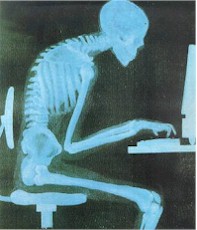
Perhaps I should have mentioned this earlier. It's probably more important than the exercises for the trap in the first place: posture! Nothing you do in an hour at the gym will come close to making up for 8 hours a day spent like this:
This would also explain why the better trainers are so adamant about fixing posture problems before looking to make the muscles more powerful.

Like I mentioned above, maybe I have no business talking about any of this. We choose this subculture where our body sells our message. No, I don't have humongous muscles behind my ears but of all of the aches, injuries and pains I've inflcited on myself, my shoulders have remained sound and strong. My trapezius muscle may not be as flashy but they sure as shit get the job done with minimal issues. What more could anyone ask for?

Monday, June 27, 2011

DIY T-Handle Tutorial

Be The First To Comment
Ross Enmait provides us with a great video tutorial about the DIY T-Handle


Ross covers the build and how to use it, a very good video!!

The T-Handle must be one of the top DIY builds in terms of cost and effectivness. Not sure exactly where this idea came from although I do recall Dan John using a 'Hungarian Core Blaster' back in the early 2000's which he probably got from some Hammer Throwers (it may even have originated (first introduced on Sorinex)

Check out a previous post about the DIY T-Handle
you may also be interested in a very similar device from Tim Ferris' DIY Kettlebell Handle

Saturday, June 25, 2011

Crushing the CoC's

Be The First To Comment
I'm not sure you, or they, need a review of their flagship product by now. The Captains of Crush grippers are pretty well-known to a lot of subculturists. It's not like I need to tell you that they rock or that they're a first-class product. Still, if you come to my blog to see what I've been doing or what I think works or not, then this is what I think about the CoC's.

THEY DO ROCK!

I have no idea about the history of these style of grippers. Some random memory neuron in my mind recalls seeing one of these from the 1950s. Since a lot of fitness equipment follows the same trajectory into the mainstream, I guess that somewhere along the line, someone took this formerly-awesome gripper and then mass-produced it down to the plastic-handled jobby that my 3 week old son Henry could probably squeeze shut for 5 reps. We went from something that could make a strong grip to something that our girlfriends, terrified of having real muscle, could use to tone their forearms.

So, I never gave much thought to this tool. All it was to me was a junk-style exercise thing that showed up in the sporting goods department at K-mart.

Then, I had a change of heart. I decided to buy the Trainer and the #1 for the plane ride out to Sacramento. I had to get my work stuff and I figured that they might be something I could do when I'm driving back across the fruited plains as well. These things, when you count the shipping, run around $20-$25 each. There isn't much to them. They're an aluminum handle with a steel spring. There isn't much to screw up and make poorly and Ironmind doesn't screw them up. They are very nicely made! As you move up in difficulty, the springs stock increases in diameter. You might not even notice unless you put them side-to-side.

You will when you grip them! This was immediately fun! After burning into my mind that this genre of gripper was garbage, I was taken back. I even went overboard using things. Ironmind recommends using these things two or three times a week, treating this as seriously as any other workout you'd do. That's good advice to heed. By the time I hit Wyoming, my hands were ACHING.

That is the downside of this style of training, I guess. Furthermore, it's good to balance this out with some extension exercises. Ironmind knows how to sell stuff. They include in their instructions a plug for their glorified rubber bands. I prefer some sort of fingertip push-ups.

On the plus side, after I got rid of that new toy enthusiasm and started getting serious about using the CoC, I couldn't believe how well that these work. After two weeks of using these, I tacked on two more reps to my 3.5" thick bar pull-ups and three reps back onto my fingertip HSPU's and OAP's. I haven't had such a quick increase in grip strength since I took up rope climbing.

I started out being able to close the trainer but struggled with the #1. Now, I can close both reasonably easy so I bumped up to the #2. I'm not closing that one yet. I'm stuck at a partial close for time. I'll just enjoy the journey like I'm enjoying the CoC's.

Ironmind

Friday, June 24, 2011

Dip Stands

Be The First To Comment
Today I'll show you how to construct a space saving dip station. You can use scrap wood to keep the cost down. This is another project that can end up being free or very cheap, while at the same time recycling old material. These are an addition to the saw horse safety stands. This was an old project but I have since refined and significantly improved it.


Cost: around $20 (depending on what scrap materials you have)
Project Time: a few hours plus time for glue to dry
Difficulty: This one requires the ability to cut wood with the saw of your choice, as well as the competence to use a drill, which is to say hold a button while pressing the drill toward the material. You also have to drive screws.

Tools Needed:
  • Drill
  • 1 3/4 inch (44 mm) hole saw bit
  • Screwdriver
  • Saw to cut plywood (circular saw, hand saw, etc.)
  • Saw to cut studs (miter saw, hand saw, circular saw, etc.)
  • Hack Saw - to cut pipe (optional, you can buy it pre cut or have the store do it)

Materials Needed:
  • 2x4 Studs (38 x 88mm) - one long board or just use scraps, we need eight pieces about 5" long (13 cm)
  • Wood screws - I prefer ones like THESE; you need 12 screws for this project.
  • Scrap lengths of "plywood" - the size of your saw horse tops; oriented strand board is what I use.
  • Paint (optional)
  • 2 adjustable height saw horses (you should already have these)
  • 2 Bolts - You want the length to be right about 2 1/2 inches (63 mm). Diameter can vary but around size #10 is good (that's 5M for metric users).
  • 1 1/4 inch diameter metal pipe - you need two pieces roughly 1 foot long each (30 cm). * Though it's labeled 1 1/4 inch, pipe like this actually has an outer diameter of 1.6 inches (42 mm).


    This project is an add on for our saw horse safety stands. The saw horses, as I discussed in a previous entry are used as safety stands for the squat and bench press, to accompany the homemade squat stands, which I've also already covered in a previous post. If you are making a similar setup you should already have the saw horses to be used for safety stands, like I do. If you do not have such a setup, and perhaps you have a power rack instead, then you may want to look past this project or you can locate one of many different designs for stand alone dip bars on the internet. That would probably be cheaper than spending $40 on saw horses just to do dips. But then again, you know this will be as strong as you need it to be since each sawhorse is rated for over 1000 lbs.

    If you do go another route I'll offer some advice. There are several designs out there on the net. I would recommend you go with a wooden option, particularly if you intend to dip heavy. If you're just messing around with bodyweight dips (why are you not adding weight?) then the PVC options are probably okay. But if you're talking about doing dips seriously, then you need something strong enough to take your bodyweight, which could be 200+ lbs. and another hundred or several hundred lbs. on top of that. You want something solid that you know will hold up.

    Also keep in mind the prices. Go to the store and get a feel for what each design would cost. 2x4 wood is usually cheaper than  a bunch of plumbing parts. I may very well make such a stand alone dip station in the future because merely typing this paragraph already has the ideas flying around in my head. I'm quite certain I could make one that is both strong, adjustable, and will "fold" up for easier storage. Anyway, getting on with THIS project.

    I decided to make these because I had a problem. I wanted to add dips to my repertoire but I didn't want something that had to mount to the wall. I wanted it to have a low footprint that could be moved and stored. I also thought that the "between two chairs" idea was lame. It works, sure, at least for body weight dips. It also hurts the fuck out of your hands. And everyone knows you can lift a hell of a lot more when there's an ample supply of fuck in the tissues of the hand.The reason this is so, is because the backs of folding chairs are quite small in terms of surface area, and that means lots of psi (pressure) on your hands.

    The first piece we're going to make is the plywood base. See the Material Dictionary for suitable plywood replacements. I personally always use Oriented Strand Board, though I usually just call it "plywood" even though it's not. Measure the length and width of the top of your saw horse. Alternatively, you could simply take the sawhorse out to the garage, put it on the plywood and trace around it. If you do that, mark your plywood through the hole on each end of the saw horse. Now simply cut the piece of plywood. You should now have a piece of plywood roughly the size of the top of your saw horse. Remember to then mark and drill holes through the plywood that line up with the holes in each end of your sawhorse

    * My instructions are for a single stand/handle. Since you need to make two, remember to repeat the whole procedure to make another one.

    Now we'll make our 2x4 posts. At first glance you may ask, "why not simply use 4x4s instead?" The answer is in the pipe. We're using "1 1/4 inch pipe" which actually has an outer diameter of 1.6 inches (42 mm). This is key because it's more comfortable to use than smaller pipe; the outside diameter of this pipe closely resembles gymnastic parallel bars in size. In order to duplicate our design using 4x4 posts we would need to be able to bore out a hole halfway through the post. To do this we would need something called a Forstner bit, and they are not cheap, especially in the store. Online they are not too bad but still not as cheap as hole saws. Normal wood boring bits aren't big enough to make the hole we need to fit our 1.6 (42mm) OD pipe. I wouldn't possibly ask you to spend $30 on a tool you'll use for one project. So instead, we'll use 2x4s (38 x 88mm) and a 1 3/4 inch (44 mm) hole saw.

    Take a length of 2x4 board and measure roughly 1 5/8 inches (41 mm) down from one end. Put a dot here, centered in the width of your board. This is the mark that the center bit of your hole saw will go on. Line it up and drill all the way through the thickness of your board. Now measure about 5 inches (13 cm) from the edge (same edge as before), mark a line and cut the board. You've produced your first board with a hole near the top. You'll need to repeat this procedure again, so now you have two. That's the hard part. Now cut two more pieces of 2x4, each 5 inches (13 cm) in length. But don't drill the holes in these last two.

    With nearly no square footage, if a bird had to live here, he'd be pissed.

    We're going to compile our first "birdhouse" piece. I call it that because is somewhat resembles a birdhouse when done. Take one of the boards you drilled the big hole in and stack it on top of one of the matching boards with no hole in it. Now drill a hole through the top board and into the bottom board, more or less centered in the space below the big hole you cut out. If you bit isn't long enough to get good depth in the bottom board, remove the top board and drill out the bottom board further. Read on for clarity before you do all this.

    This is going to be a pre drilled hole for your screws so the drill bit you use should be smaller than the diameter of your screws. For all my projects, I like to use 2 1/2 inch (63 mm) T-25 star bit screws designed for external uses such as decks or sheds. You certainly don't need something that beefy for this particular application but those are the screws I always have so those are the ones I use. In any case, pre drill holes or don't complain to me if you split your wood.

    Pre drilling your holes is important in this project. You must drill these holes. If you just drive the screws into bare wood the odds are you're going to split the board. After all the work you did with the hole saw you will not be happy if this happens. Pre drill these holes and drive in your screws by hand or slowly with a drill and you'll be safe from that unwanted fate. But before you put the screw in, slather some wood glue in between the boards. We're only putting one screw in (no room for more without splitting the wood) so the wood glue will provide the extra strength.

    If you have clamps then clamp this piece down on itself while it dries. If not, just put it on the floor and put something heavy on it. I used a patio brick since that was the closest heavy thing. Once dry, the wood glue alone will make this piece so strong you couldn't get it apart if you wanted to. Repeat this step for the other remaining blocks. When it's dry you'll have two birdhouses.

    Now on to the pipe. You need roughly a 12 inch (30 cm) length of this pipe. You can buy it already cut into these lengths (more expensive) or you can buy a long 10 foot pipe and have the store cut it up for you (more hassle), or you could cut it at home yourself (more work). In the interest of maximum time savings I personally just bought a pair of already cut pipes.

    The pipe is probably quite grimy so clean it up first using either steel wool or the rough side of a sponge and some soap. If you have an electric sander and want your pipe to look super cool, put your sander to it. Sand the entire pipe (with the sander powered on of course), moving the sander in small circles, like the Karate Kid. "Wax on." This won't create a knurling or anything like that. It will simply put fine scratches in it and polish it up and give the pipe a "brushed" shiny look. It will still feel perfectly smooth to the touch but it looks fancier.


    The next step is to attach this all to the plywood base. The best way to do this is to turn your bird houses upside down (hole closer to the bottom) and holes facing toward each other. Fit the pipe into the bird houses and push them together as far as they go so the pipe if fully in at both ends. Simply put your plywood strip you cut earlier on top. Line it up and center it.

    Now drill holes for your screws through the plywood and deep into the birdhouses below (don't skip this lest you risk splitting your birdhouses). Looking at the picture you can see how I staggered the screws. I put two screws in each birdhouse, one in each 2x4, staggered (one on each side).

    That could be the end of it, if you wish. But, you'll notice that your bars are able to spin right now. I don't know if there would be a valid reason for wanting that but I opted to secure mine so they don't spin. To do this, first take the bit you've been using to pre drill holes for your screws. This should be slightly smaller than the #10 (5M) bolts you're about to use. Your mark is the center of the top of the 2x4 that you drilled the big hole in earlier, directly above where the pipe sits. Drill down through the wood, do your best to make this as perfectly straight as possible. When you hit the pipe, stop for a second. Securely hold the pipe with one hand so it doesn't move around, then continue to drill at least for a little while to ensure that this spot is marked on your pipe.

    A bolt through the top makes the spinning stop.

    Take the screws out of the bottom of your plywood for one of your birdhouses. This will allow you to take the pipe out. Switch to a bit that is just a bit bigger than your chosen bolt's diameter. You need this bolt to be able to fit through the pipe but you also don't want the hole so big that there is slack for the pipe to greatly move around either. Drill through the pipe on the spot you marked. Since the pipe is hollow, take care to make sure you keep your bit straight once you get through the top edge of your pipe and are working on the bottom. Once you're completely through the pipe, fit your bolt in to ensure that everything fits.


    Reassemble the handle and screw it back into the plywood base. Then take that same smaller drill bit that you use to pre drill for screws. Hold it up against the side of your birdhouse next to the pipe to make sure it's long enough to get from the top though the pipe. Bits of this size typically should be. If you have to take a shallow grip on it with your drill, that's okay. Feed it in through both holes in the pipe and drill through the bottom wood as far as you can or as much as you need for your bolt.

    Now you can screw in your bolt. Of course, it's a bolt, not a wood screw so it's not designed to bore into wood, but it does have metal threads and they will do that to an extent. This is why we pre drilled holes that were slightly smaller than the diameter of our bolt. It will dig into the wood and secure itself a little more by doing so. If the hole is too small and the bolt doesn't easily screw in then drill the hole bigger. If you wish, you could use a wood or metal screw but in my testing a bolt ends up providing more stability (no wiggle) for our pipe. You can choose to slightly counter sink the head of your bolt if you wish. That simply means you need to drill out a bigger shallow hole at the top so that the head has room to go below the surface of the wood.

    There's nothing wrong with square corners, unless you're a square hating enthusiast like me.

    You can also choose to round the outside edges of your birdhouses. I did it and it's purely for aesthetic reasons. If you want to copy me, simply use a hand saw to lop of the corner, then sand them down to a curve. A coping saw works well for this because it's so small you can be very accurate with it. But a normal hand saw works too as long as you're careful. A router would be the power tool way to speed things up but if you have a router you don't need me to tell you to use it for this task.

    So that's one handle done. Repeat the whole procedure for the other handle, though I'm assuming you already did most of it while your birdhouses were drying. You can paint them if you want. I did because I had to make them match the rest of my equipment (squat stands and bench). They do not, however, match my purse. I have a purple sequence purse, everybody knows that it's the hottest thing right now.

    Of course, as it stands they aren't very secure on top of your sawhorses because they are not attached to the saw horses in any way. That's why we drilled the holes in the plywood corresponding to the holes in each end of the saw horses. If you are using different sawhorses than I, and yours do not have holes, then drill them yourself if possible.


    You can secure your attachments to your saw horses with a bolt and nut (use a wing nut on top for easy no tool tightening/loosening ability). You can also simply use an allen wrench like a pin. Just like I mention in the original saw horse safety catches post, I simply put a sufficiently sized allen wrench through the hole. The L shape, and length, of the wrench holds the addition in place. I haven't noticed any instability or wobbling yet but if that is the case then just bolt them down to your saw horses.

    The saw horses are adjustable so if you need to you can raise them to accommodate your body. This can be a bit of a hassle but it's the price you pay for the benefit of having equipment to has multiple functions. It saves space and I deem it worth the bit of time it takes to adjust the sawhorses to convert them from dip station to safety stands.

    I have read that, in general, the right distance between the two bars should be the distance from your elbow to fingertips. I don't know if that's universally true, but it seems to work well enough for me. In any case you can position these as far apart as you choose.

    If you're also interested in a DIY dipping belt, click here.

    -Carl

    Tuesday, June 21, 2011

    Generation ROT!

    Be The First To Comment
    40 Horsepower Electric Motor

    The repair man and I stood before it in front of my truck. He looked at it nervously, asking me how we were going to get it into my pick-up truck. His face seemed to tighten up in a combination of what looked like equal parts fear and question. As he started to bend over to grab this sucker, I squatted down and rapidly scooped it up and gently placed it in my truck.

    I lifted a 382 lbs electric motor???

    Actually... no. I lifted the Variable Frequency Drive that controls the speed of the motor. For those of you not familiar with a VFD, it's basically a computer that runs Tesla's greatest gift to mankind, and it barely weighs 60 lbs. So, why in the hell was this kid, who has to be about my age, twisting himself up, questioning how the hell two men, supposedly at their physical peak, going to handle such a modest piece of equipment?

    Welcome to Generation ROT!

    This kid, physically speaking, was a tribute to our epoch of degeneration: Corn Syrup fattened with shoulders and a neck custom-destroyed to make out the slightest detail on any 1080p screen put in front of his face. All around me, I'm watching my peers wreck themselves at a rate that has some predicting my generation will be the first to live shorter lives than their parents in a long time. While we try to figure out how to enjoy the less time we have on earth, we're guaranteed to have a shit-storm of ailments brought on by this eat-shit-don't-do-shit way of life. No wonder everyone's treating 30 like it's old. How many of us 30 year olds are looking at ourselves in the mirror, knowing that our physical peak has gone by when in the back of our head, we know it should still be going on?

    Seriously, professional athletes in most sports are at their absolute best between the ages of 27-32. There should be no fucking reason to treat this like the gateway of old age!

    Nothing's getting better either. My wife had me watch Jamie Oliver's food revolution. It's downright fucking horrid how little people know, or even care, about what they eat anymore. With all due respect to Oliver's work (which I appreciate very much) if anyone gave a fuck, they'd figure out how to eat right on their own regardless if school taught them to or not. Never before in the history of humankind has more information been available on such a vast scale to even the youngest of our physically-degraded population. If they wanted to know, they'd could figure it out. It's all just a google search away!

    Speaking of Google, I did a little experiment, typing in the following words and recording the number of hits. Maybe we can draw some conclusions about what information people most want to know about...

    Eating right...39,300,000 results
    Strength training: 54,300,000 results
    Justin Bieber: 445,000,000 results
    Free Porn: 394,000,000 results
    Lady GaGa: 549,000,000 results
    Selena Gomez: 194,000,000 results
    Jersey Shore: 72,500,000 results
    OWN: 4,080,000,000 results
    Fat and sexy: 162,000,000 results

    It's nice to see where our priorities lay...

    It seems to me that what we care about most is being indifferent and lazy. People don't want to know and they don't even care that they're rotting on the inside. Hell, I see and hear the healthy and strong mocked as much as their messages are even given half-attention to. When you think about it, the extreme popularity of the plague driven, flesh-rotted zombie makes for a great mascot of generation ROT! This generation has descended into degraded bodies moving around with no sense of direction or control over themselves... they just want to eat!
    Some suggest that it's someone else's responsibility to wake up this pile of fatties and make them get into shape. Who exactly is supposed to do that? Maybe our pack-a-day, hen-pecked president who can't seem to stop face-fucking every fast food restaurant he can whenever he's away from Michelle? Or, maybe congress can do something about it. Then again maybe not. It doesn't seem like they know what the gym is supposed to be used for these days, do they?

    Is this one too many cheap shots? Well, don't forget, this is the same bunch of clowns who subsidize the very crops that get our peeps fat, gave us that atrocious food pyramid guide to eat "healthy", and say that giving the kiddies chicken nuggets at school is perfectly alright. You know that's a short list too but let's face facts: no government anywhere has shown either the good judgement or the qualifications to feed a fucking sewer rat properly, say nothing about the future generation of degenerates expected to take their place!

    If this is ever going to get better, then people need to WANT to do it for themselves... or be forced into it by necessity. That first option is hard but I can guarantee that the second one will suck even more. I don't expect one, angry blog rant to make any difference but at least I got this off of my chest. For now.
     

    © 2015 Strength Training Program - Designed by Mukund | ToS | Privacy Policy | Sitemap

    Hide
    X