Saturday, January 29, 2011

Does Strength Training Need a Church?

Be The First To Comment

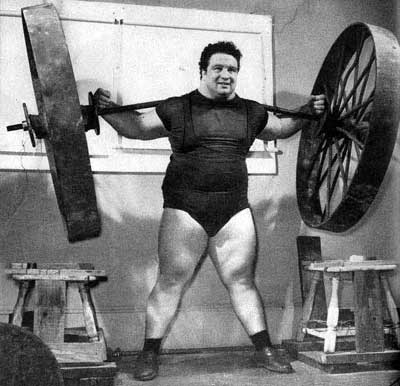
Paul Anderson is a bit of an anomaly in the strength training world. No, it's not just because equipment manufacturers couldn't make barbell sets heavy enough to give him a challenge. It's also because he was one of the few truly elite lifters in physical culture history that was also extremely religious. A very devout christian, after his he retired from competition, he founded a very successful home for troubled youth.

Historically, that kind of devotion to a religion hasn't been immensely popular in Western Physical Culture. We can all speculate as to why that is but I think that the answer is simple and much the same reason many others shun religion: they don't like to be told that what they're doing might be wrong. For example, Sandow could, and pretty much did, nail every available (and married) woman that attended his encore, look AND touch private show that he wanted. Depending on who you chose to believe, that list might have included a few men here and there too. The last thing he or any other good-looking muscular guy wants to hear is some bible-thumping holy man preaching the evils of promiscuous sex and adultery to them.

Anyway, strength trainers have a tendancy to be self-indulgent and self-absorbed. So, they avoid the divine wagging finger (for now?). Oddly enough, they kind of do have a religion and a church. Regardless of how they decide to tug on iron and to what end they hope to accomplish by doing it, I think that the case could be made that training has been turned into a religion.

Think about it for a moment. It doesn't take much of a stretch. They have their very narrow beliefs (their strength training protocol) that revolve around certain rituals and rites of passage (their competitions). They have their sacraments and/or magic potions that guarantee them divinity and enlightenment(supplements and PED's). They have their sacred relics (the iron and the machines they work out on). They also are very rigid in their whole outlook on things and will bitterly argue and deride any other differing views(Functional Strength Training vs. Oly vs. Bodybuilding vs Crossfit vs Powerlifting vs Bodyweight vs Strongman vs whateverthefuck) other than their own.

Above all, the salvation of strength must come from a gym. While they'd prefer it to come from their gym, they all agree that it has to come from working out in a gym. Otherwise, it's not possible to get strong. You don't have the relics, after all! That's the one that I challenge the most. Being told that I couldn't get strong without weights or a gym by my wife's ex-trainer lit a fire under my ass that burns pretty bright to this day, long after I accomplished what set out to do.

Although I'm known as a Bodyweight guy, I'm truly non-denominational. I've never had anything against weights, just that they cost money and they're not quite as easy to travel with. I look at the Earth as my gym. All I have to do is look at it with some imagination and I see my strength training relics. For example, take a look at this pic I just snapped at work on my phone...

What do you see?

A set of stairs, some railing and a doorway?

Geeze, you're boring! It's an exercise station where I can do the following stuff:


1. Pull-ups
2. Chin-ups
3. Hanging Leg Raises
4. Hanging Windshield wipers
5. L-Sits
6. Dips
7. Feet-elevated Push-ups
8. Plyometric stair jumping
I'm guessing that you could easily make up two workouts based on this short list of exercises!

Wait just a minute...How can you get strong from that? How can you possibly make that work with a 5/3/1 or a 5x5 or an 8x6x7x5x3x0x9 routine? How could that help my bench? None of this is functional! Really? How horrid!

While I choose not to comment the need of a religion and/or a church for the spirit at the moment, I will say that I don't think one is needed for the body. Like religion for the spirit, I do think that it would suit people to take a step back and realize that they don't need to be so rigid and unforgiving in their strength belief systems. Why not focus on what they all have in common and in reality, what they have in common is more important than the differences. Those are lots of minor things that don't really amount to much. We all agree that doing really difficult movements with lots of intensity and/or speed will make us really strong. Why do we need to bicker about specific means to the end?


A quick walk around most religions also yields a conclusion that most of them aren't big on idolatry. It seems to have fallen out of style everywhere except strength training religions. Strength isn't dependent on having stuff. It's how you use what you have on hand (within reason) that makes the difference. Hell, I've spent the past three years talking about how I get strong with no implements at all (most of the time)!

Closed minds never solve anything. Not in the matters of the soul or the body. Strength is plastic. Malleable. So, the ways it's developed are much the same. So, the place that it's built isn't that important. The end does justify the means in this case. Get it however and where-ever you can.

Friday, January 28, 2011

What's Reps Got to Do With it?

Be The First To Comment
There's a lot of small details that people get way too caught up in when they decide to induce muscle hypertropy. One of them are reps, specifically how many to for muscle growth. Generally, you'll hear people toss out things like 3-5 for strength, 8-12 for muscle growth, and anything beyond that is just endurance.

I'd love to know where that all came from. If anyone knows, please drop me a line. Or, is this a case that proves the point, "success has many parents and failure is an orphan?"

For as long as I've trained, I've never bought into that. Back in 2007, i grew my upper back and arms (in addition to my entire body) by doing pull-ups and chin-ups in 15-20 rep ranges. How did that happen? I discussed this a while back, in this post.

I don't see the point in regurgitating old posts yet again. Besides, like any other form of regurgitation, people don't generally have positive reaction to it. I do have something to add to it, to further get the mind off of the strict importance of rep ranges.

Lately, I've been doing quite a few exercises that render it impossible to fit into the normal, pretty category of one rep. When we think of an exercise, we're kind of accustomed to a movement that has a definitive concentric (muscle shortens) movement followed by an eccentric (muscle lengthens) movement... or sometimes the other way around. Either way, put them together, and you've got A REP!

What about rope climbing? Going up is nothing but concentric movement. Going down is nothing but eccentric movement. What do you consider one rep on that? What's the rep range for building size and strength on that one? I can certainly vouch that it can! Or, what about any kind of carrying or farmers walk work? Does it even have concentric and eccentric movement? Better still, how about pushing a car? Most people that do car pushing do a lot more than just 20 "pushes" in the scheme of doing so. Is that just endurance? Try it and get back to me...and don't be a smart ass and use a SmartCar!

Definitely Strength-Endurance!

What's also very interesting about these three is that if you ask anyone who has done them with any kind of frequency, they'll tell you that you can, and will, get brutally strong with them.

Hey! There's a workout for you: Rope climb, truck push, and farmers walks. PhunSHUNcTal too!

This kind of brings up another angle to muscle confusion. By destroying the typical eccentric+concentric=one rep movement that makes up most exercises, we have another angle to building some awesome strength. Let's level with each other: after a while, if we get tired enough, our body instinctively finds ways to make the rep easier, usually by dropping out the controlled, eccentric movement. You can't do that when you're hanging 12' off the ground anymore (unless you love sore elbows, or the the sensation of hitting the ground from the top of the rope).

That's why I'd rather think in terms of amount of time under contraction rather than reps. I will say that for a beginner, giving rep ranges have their place. They make for a good starting point. Besides, a lot of the exercises (maybe the concept of scrambling concentric+eccentric=rep isn't for beginners anyway) I described aren't exactly beginner's movements. It just goes to show that there isn't this carved-in-stone rulebook to getting big, buff, powerful and sexy.

Wednesday, January 26, 2011

Jack Lalanne... and what his death is saying about us

Be The First To Comment


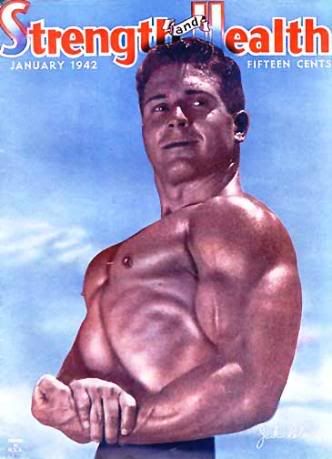
You don't see this picture very often in my very humble basement gym but it's my favorite picture that I've hung up. Several years ago, my wife wrote to and called Jack Lalanne, asking for an autograph (and possibly a phone call) for me. His agent arranged the former. I was so thrilled that I had it professionally laminated so it would, hopefully, last as long as the man himself did. Now we know how long it has to last to live up to the man himself: 96 years.


I was positively crushed when George "HIT" Richards reported on his Facebook profile on Sunday night that Jack Lalanne passed away. I have no illusions that he was going to live forever. We all owe a death at some point. It hurts to lose such great people though. There's a real shortage of them left in this world. Having him for as long as we did was a unique gift: he might have been the last of the original "Muscle Beach" crowd. He was part of the second wave of physical culturists who formed strength training world as we now know it.

His posse of iron men and women established California as a mecca for health and fitness that it is to this day. They made gyms and health spas popular in the USA. They brought fitness to the new media. It wasn't just Jack Lalanne's TV show. These guys trained most of the actors and stuntmen in Hollywood. Everything that we do now can be traced back to Jack and his friends. He was the bridge between the early Sandow years and the modern world of strength training as we know it.


In my opinion, this was also the greatest generation of strength trainers. We could go on about his physical feats, his Television show, and his juice machine but that really misses the real greatness of Jack Lalanne. This man can lay a solid claim to being the greatest example of how to nurture a body for the purpose of serving a greater purpose...EVER. Inner light can't shine through dirty windows and showed us, by example, how to let that light through. It's hard to put that kind of inspiration into words. It's something that anyone who has ever turned themselves from physically weak to physically strong can understand.


that transformation must be unpopular these days because I'm very underwhelmed, and frankly pretty pissed, at some of the coverage of his death. I detected a grain of mockery coming from people I hear on the news regarding his death. I've heard more references to his drunk driving arrest back in 1991 than I ever heard about Ted Kennedy's drinking binges when he died. I heard quips about his strict anti-sugar, quasi-vegetarian diet..."and he still died!" Or, about how he preached health and fitness as America got more and more unhealthy?


This evening turned into one of those, "what has America become?" moments. We lost someone who was an outrageously productive human being who we could trust to be an honest and good example to our children and we find reasons to point out how he wasn't perfect? Are we only happy if we see trashy excuses of human life shoved into our eyeballs on the tube?

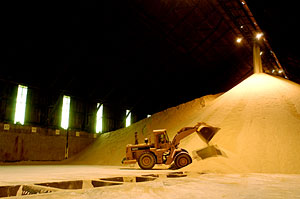
Seriously though, what have we become? Can't we hold virtuous life with high regard? Why do we think it's okay to glorify how mediocre and internally filthy we've become? Is it funny that most of us eat about 160 lbs of refined sugar a year that we know is going to slowly kills us? Who is really insane here: most of us for doing this or Jack Lalanne for telling us for the past 60 years that this is suicidal?


What do you think? Enough sugar for a medium-sized American Town?

I think it comes down to judgement. Simply put: nobody wants to be told that what they're doing just plain sucks, even when it's so lately fucking stupid that it shouldn't even be a debate. Another mark of a great man is that they'll tell you the truth, no matter how badly it hurts. Jack told it to us straight, right up to the very end.


His example of lifelong clean, health, and strong living was the best idea for a goal that he gave his audience. We all love to set goals for ourselves. It's a tangible way of seeing progress. Those are all groovy things, don't get me wrong, but keeping ourselves healthy and strong for a lifetime could be the best goal to make. A healthy life makes all time spent training, regardless of how fun or how obligatory, a step in the right direction to fulfilling. Jack Lalanne said it best:


"People don’t die of old age, they die of inactivity."


"Better to wear out than rust out"


With that as a goal, every ounce of activity becomes meaningful; a middle finger given to the notion of a diseased life and dampened spirit. I thank you, Jack Lalanne, for that. We all do.


Tuesday, January 25, 2011

Awesome and Cheap Homemade Push Pull Sled

Be The First To Comment
Ryan Pitts demonstrating how easy it is to make a simple push pull sled using the base of a wheel barrow


http://www.youtube.com/watch?v=uLCbX89Ut5w

Gear required:

Old wheel barrow
Chain
Threaded u bar or ane eye of some kind
weights or rubble to add resistance

Sunday, January 23, 2011

Lat Pulldown - Modified

Be The First To Comment
Lat Pulldown - Modified

Pat from HomemadeGymStuff has put up a great idea for hitting the lats more effectively with a homemade modified lat pulldown bar.

Equipment needed:
Hollow bar - or some imagination will do!
Stretch band
Lat machine or some pulldown/pulley device.


http://www.youtube.com/watch?v=1qOOz32huv4

Saturday, January 22, 2011

Why Didn't I think of this before?

Be The First To Comment
Calves are, without a doubt, Just about everyone's hardest body part to build any kind of muscle on as well as that one part of the body that just about everyone doesn't like on themselves. I can certainly count myself as part of that group. I admit that I have thin calves. Some of you may recall that I wanted to focus more on exercises for my lower body, trying to improve on them, particularly the harder pistols and Glute-Ham raises (GHR). The GHR got moved to the top of that list.

I've barely been working at these for two weeks and I'm dumbfounded and stunned as to how fast my calves responded to my GHR work. I'm not doing full-blown GHR's at the moment. I can get about halfway down before I drop and I can push myself up off the ground with my hands. Either way, My calves are really starting to respond. What's going on here? I thought that this was supposed to be the most stubborn muscle to grow?

Well, I was walking around, thinking about my achy calves when it hit me what's going on here...

We all know that the heel raise is the standard method to getting the calves bigger. The trouble is, it works for some people and seemingly not at all for others. The common answer is to add more weight. It's the same situation: for some it works, for others it still doesn't. This is what hit me: it's not that some people aren't adding enough weight. The problem is that their feet have the wrong leverage to make the move work for them!

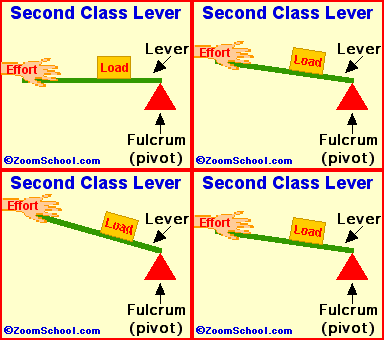
Note that I didn't say bad leverage. I said WRONG LEVERAGE. Open up any anatomy book and there will be a section discussing the three classes of levers. The heel raising up off the ground is a classic, class 2 lever...


This may not makes sense from here on out unless you do a little reading.
***Disclaimer: I'm not an expert on leverage in relation to the body. I only understand this if I read it and study it enough, over and over and over. I only get what I'm talking about because I experimented and read about it!***


Class 2 levers are more efficient at moving a load if the lever itself is longer. A good example is nail clippers. They're class 2, just like a heel raise. We use toe nail clippers because they are bigger and apply more force to cut through the much-thicker toenail. So, if a person has long feet, relative to their ankles, then the lever is more efficient.

The trouble with that relative to strength training is that the gastrocnemius (calf muscle), in turn, doesn't have to work harder. Remember, muscles only get bigger only when forced to do something really hard. So, good second class lever/long foot equals small calves! This is why women often have more muscular calves than men: smaller feet!

SHOW-OFF!!

Are you with me so far?

So, unless a person with long feet has the capability to pack on some ungodly amounts of weight on a bar, a calf raise is probably not a good exercise for them. So, where do we turn? You guessed it: Change the leverage... ENTER THE GLUTE-HAM RAISE!

We get so caught up in the heel-raising experience of the calf that we neglect it's other job: It also helps flex our knee. Take a look at this picture of the calf muscle...

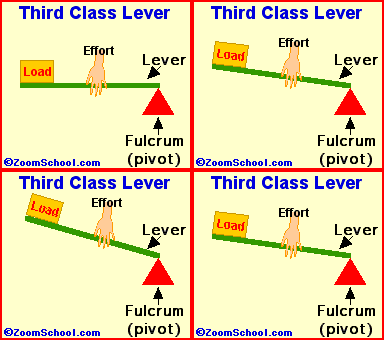
See how it connects to the femur, above the knee? By doing a GHR, it's not working as a class 2 lever anymore. Now, it's working as the much less efficient class 3 lever (did you read that page like I told you to?) Since it's functioning in a more inefficient manner, it really has to work. More work=more strain=bigger muscle!

The knee joint is the fulcrum, the force comes from the calf muscle's origin at the femur, and the load is the body. Get it?

That isn't to say that the GHR is the only exercise that forces the calf to work as a class 3 lever. Anything that forces it to flex the knee helps. This is why hikers and bicyclists have such muscular calves too!

Sure, it takes some technical reading to understand all of this stuff and I hope I've done a decent job of simplifying it enough for the masses to understand. What I don't get is why on earth this isn't mentioned more often by the people we (half) expect to know this (our trainers, books, etc). Is it ignorance or willfully holding back quality information? I leave it to you to speculate.

In the meantime, I'm going to keep plugging away at the GHR's. It's always nice to see results!

Friday, January 21, 2011

The Strong Image

Be The First To Comment
Pop Quiz(for those who know nothing about MMA): Which of these guys has the highest win percentage?

OR...


Answer: The guy at the top is Phil Baroni, the brash and trash-talking MMA punching bag with a 13-13 record. The guy at the bottom is Anderson Silva, a fighter who could lay a solid claim to being one of the greatest MMA fighters of all time, who has a 27-4 record.

Obviously, for those more knowledgeable in all matters of MMA, Silva is a far more technically sound fighter than Baroni will ever hope to be. Fighting has little to do with how a body looks and it's all about the skills it can perform. Just the same, those of us who watch him know that Anderson Silva is a powerful striker. On the other side of the coin, the body-beautiful Baroni, a guy who's graced the cover of Muscle and Fitness, makes a most basic mistake: a body isn't strong and powerful just because it looks strong and powerful. It looks good though!

This is hardly a new phenomenon. After Eugen Sandow realized (courtesy of Arthur Saxon) that he wasn't the strongest guy out on the Vaudeville Circuit anymore, his shows changed. It became more of a display of his body first and a strongman act second. That played into the bigger scheme of things anyway because most of his shows' attendees were more interested in how he looked anyway. That may have marked the beginning of the slow, but sure, separation between looking strong and being strong. Sandow was perfectly fine with looking part of "the world's strongest man" the part rather than being the part. The former was far easier to pull off.

It's hard to completely cut down the imagery of strength though. Although there were other contemporaries of Sandow operating, the the mere image of muscular strength, for all of its benefits, was a sure indicator that the owner of the hyper-developed muscles was a low-class laborer. The ideal male image, for a long time, alternated between being extremely thin (proof they didn't do any manual labor)or extremely fat(Proof they had enough money to eat as much as they cared to and did move/labor much).

The funny thing that eventually emerged after Sandow was, of course, aethetic bodybuilding. They carried on the tradition of the look of strength being more important than the ownership (that's not to say they weren't strong, it just means that it was secondary). The illusion began to shape their reality: train for shape and strength will follow.

It's also interesting to note who shaped that image. A Google Image search of any name bodybuilder (Take your pick: Jack Lalanne, Dan Lurie, Earle Liederman, John Grimek, Tony Samsone, Arnold, etc) from the 1920's to the 1970's will, in all likelihood, turn up some sort of gay erotica. An unknown, but probably very large, portion of the early bodybuilding fans were gay men. It could be said that that image of strength for most of the 20th century was tailored to be homoerotic. Nearly all of the major bodybuilding photographers were gay. Joe Weider knew what he was doing when he started his shirt-pocket sized "Adonis" magazine.
I wonder what Phil Baroni would say to that.

Shots never fired always miss. The ideal about the relationship between men's physical ability and physical appearance has fired several shots and missed more than a few times. It's a better track record than the opposite sex. Generally speaking, any display of anything remotely resembling muscular power has been strictly off-limits in the feminine image for as long as the names, "physical culture", "strength training", or "bodybuilding" have existed. The awe that this ad inspired kind of annoyed me. I recall this ad with Jennifer Anniston being some sort of pinnacle of the fit female. Forgive me for saying this but she looks like a stick figure! Would it actually hurt to lift something meaningful other than a pekinese-esqe dumbbell? Real weight, and real strength training, doesn't turn women into men!

See me in the background? I may have been looking for a 53 lbs kettlebell that they ended up hogging! How rude!

So, what's the solution to the strong image problem? Well, I think that a good starting point would be if everyone could collectively hold up the physical ideal of people that look like they can do strong things because they ACTUALLY DO things that make them strong! Would that be too much of a leap?

I hope you're not going to ask me (or yourself) what does that look like? If you insist, then here's an idea: go out and do stuff that makes you strong. Do it with other people. Repeat this over and over. Stop looking to E! and trash-magazines for the answer. You'll start to see for yourself. These activities don't have to be anything specific, although I think that we could all use a break from the cardio-workout-saturation. Strength is platic in nature. So, its presentation is going to vary. Don't get too hung up on that. Just learn to appreciate a strong performance first and what it looks like second. That's when we'll get this whole thing straightened out.
 

© 2015 Strength Training Program - Designed by Mukund | ToS | Privacy Policy | Sitemap

Hide
X